
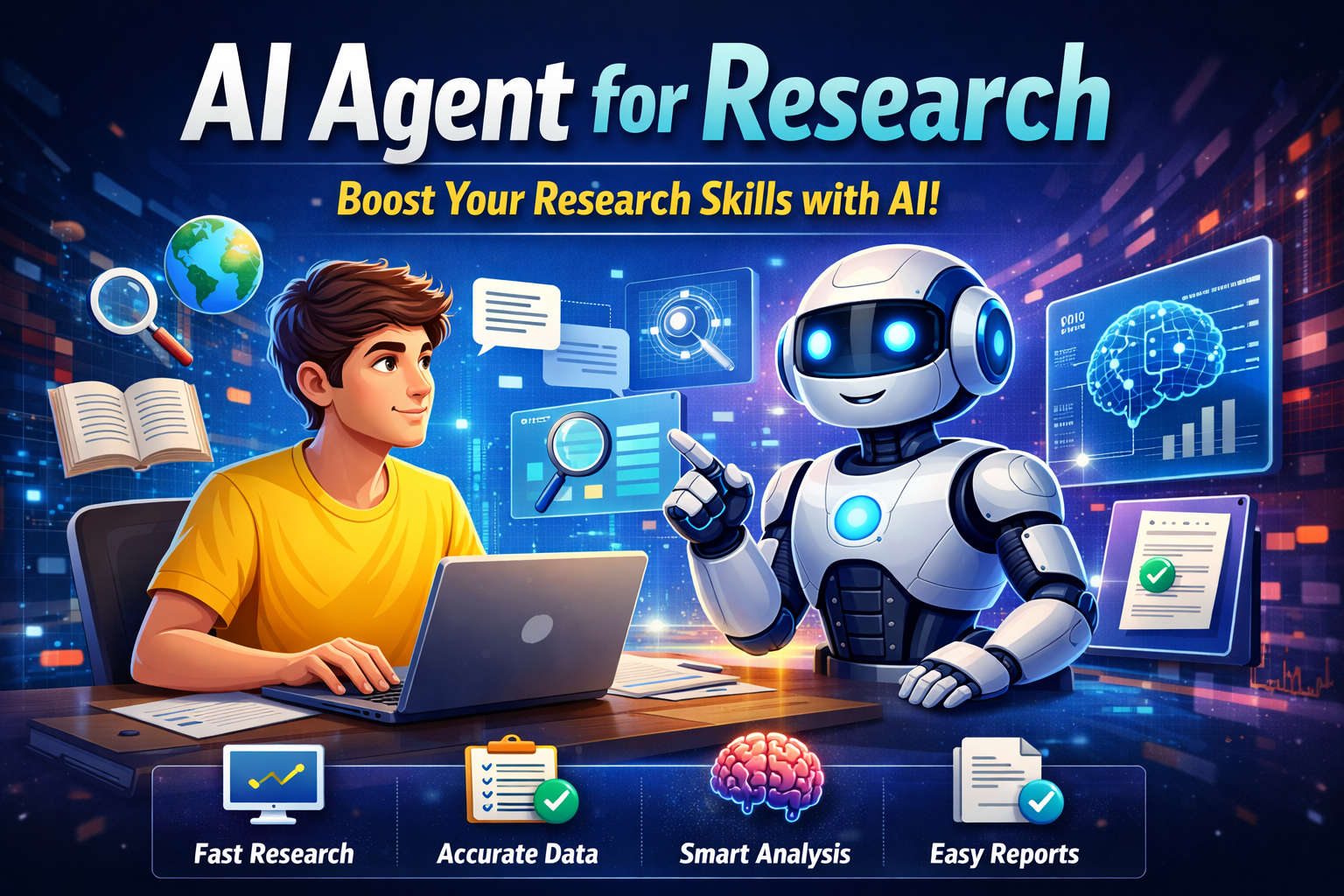
Introduction: Why was research so difficult?
Until a few years ago, research was no easy task. If you needed information on a topic, you’d search Google, then open link after link. Eventually, you’d have 15-20 tabs open. YouTube videos, blog posts, PDFs. Everywhere you’d find a little information, but never a clear answer.
Sometimes the data was outdated, sometimes the source wasn’t reliable, and sometimes the language was so technical that it was difficult to understand. The result: wasted time, confusion, and frustration.
I’ve experienced this myself. Researching a simple topic would take 3-4 hours—simply because the information was scattered. If you’re a student, a blogger, or just starting a business, you’ve probably faced this problem too. But things are changing.
This is where AI Agent for Research comes in as a game changer. It’s not just a normal chatbot. It works like a smart digital assistant that:
Scans multiple sources
Filters out important points
Creates summaries
And provides structured answers
Imagine if, instead of opening 20 tabs, you said to an intelligent system:
“I need a clear research report on this topic”—and received organized information in just a few minutes. This is the difference between traditional research and AI agents for research.
In this article, we’ll explain in simple terms how AI research agents work, how they save time, and how they can become a powerful tool for everyone from students to business owners.
What is an AI agent for research?
Now, the most important question—what is an AI agent for research?
Simply put, an AI agent is a smart software system that takes action on its own to accomplish a goal. This means you don’t just ask it a question, you give it a task—and it logically completes that task.
For example:
If you say:
“I need a detailed research summary on renewable energy with the latest trends.” A normal tool might only provide basic information.
But for research, an AI agent will: Break down the topic,Identify relevant sources, Filter the necessary data, Build a summary in a clear structure, Sometimes even suggest references. This means it’s not just an answer system, but a research assistant.
AI Agent vs. Simple Chatbot
Many people get confused, thinking that an AI agent and a chatbot are the same thing. But they are different.
What does a simple chatbot do?
Gives one answer to one question
Follows the limited context of the conversation
Does not engage in deep task planning
What does an AI agent do for research?
Understands a goal
Plans multiple steps
Collects information
Makes comparisons
Provides structured output
It’s crucial to understand this distinction.
What is the true role of a research agent?
Research isn’t just about finding information. Research means:
Identifying the right sources
Removing incorrect data
Extracting important insights
Drawing clear conclusions
The role of an AI agent for research is:
Understanding your research goal
Collecting data
Analyzing data
Presenting it in a simple and structured format
It functions much like an intelligent research assistant.
Normal AI Tool vs. Smart AI Research Agent
Let’s understand this with a simple comparison:
Normal AI Tool
One prompt → One answer
Limited deep thinking
No task breakdown
Short-term context
Smart AI Agent for Research
One goal → Several logical steps
Multi-step thinking
Uses memory
Automated data collection
Creates organized reports
Example:
If you type:
“Research startups in India.”
A normal AI tool will provide general information.
But an AI agent for research will:
Identify top industries
Look at market growth data
Check government policies
Summarize trends
Create reports with clear sections
This is the real difference.
Simple example (for a 15-year-old student)
Imagine you have a school project:
“The Impact of Social Media on Students.” If you do the research yourself:
You’ll visit 20 websites.
You’ll make notes.
You might get confused.
If you use an AI agent for research:
It will break down the topic.
It will explain the pros and cons.
It will add recent trends.
It will provide a conclusion.
And your work will be completed in half the time.
One last simple definition
In a nutshell, remember:
An AI agent for research is a smart digital assistant that automates the research process, thinks through multiple steps, and provides structured information.
It’s not just a tool for providing information – it’s a system for thinking, filtering, and organizing.
How AI Research Agents Actually Work
So far, we understand what an AI research agent is.
But the most interesting thing is how it works.
Does it just copy and paste from the internet?
Absolutely not.
A smart AI research agent follows a proper research process—just like a human researcher. Let’s explain it step-by-step in simple terms.
1. Data Collection
First, the AI agent understands your question. Then, it collects the necessary data.
In this stage, it:
Checks different sources
Scans articles, reports, blogs, and research papers
Collects important information related to the topic
This is like going to the library and looking through different books.
But the difference is that for research, an AI agent can do this in seconds or minutes.
2. Source Analysis (Which Source is Useful?)
Not all information is useful. Some sources are outdated, some are unreliable. So the next step is analysis.
The AI agent:
Checks which sources are useful
Identifies repetitive information
Ignores fake or low-quality data
This step is also important for Google E.E.A.T.—because reliable sources are essential for trustworthy research.
3. Filtering (Selecting Important Points)
Now that the data has been collected, the AI agent doesn’t give you everything.
Wow:
Selects important facts
Removes extra or unnecessary information
Combines similar ideas
Imagine 50 pages of data; the AI agent breaks it down into 5–6 clear sections for research.
This is the biggest time-saving factor.
4. Summarization (Short and Clear Explanation)
Now the next step is summarization.
AI agents:
Shorten long paragraphs
Simplify complex language
Display topics with clear headings and structure
Because of this, even a 15-year-old student can easily understand the topic.
5. Insight generation (not just a summary, but also an explanation)
This is the most powerful part.
A normal tool only provides a summary.
But a smart AI agent identifies research patterns.
Meaning:
Identifies trends
Makes comparisons
Illustrates advantages and disadvantages
Represents results
This step transforms research from “information” to “understanding.”
Simple example: “AI in healthcare”
Let’s understand with a simple example.
If you search:
“AI in healthcare”
What will an AI agent do for research?
Step 1: Explain the topic
How is AI being used in diagnosis?
How does AI help in surgery?
What is the role of AI in data analysis?
Step 2: Explore the latest trends.
AI-based disease prediction.
Medical imaging analysis.
Virtual health assistants.
Step 3: Identify the pros and cons.
Advantages:
Faster diagnosis.
Better accuracy.
Risks:
Data privacy issues.
Higher implementation costs.
Step 4: Create a structured report.
The final output will look something like this:
Introduction
Application
Advantages
Challenges
Future scope.
And you’ll get a clear understanding without opening 20 tabs.
An easy formula to remember:
AI Agent for Research = Collect + Analyze + Filter + Summarize + Explain
It’s not just an information tool, but a smart assistant that follows a structured research process.
Key Features of a Powerful AI Research Agent
Now the question is, what makes a powerful AI agent for research powerful? Not every AI tool is a research agent. A strong research agent has some special features that distinguish it from a normal chatbot.
Let’s explain these features in simple and easy language—so that even a 15-year-old student can easily understand.
1. Multi-Source Browsing
A good AI agent for research doesn’t rely solely on one website or one source.
Wow:
It checks multiple websites
Compares different viewpoints
Cross-verifies information
What are its benefits?
You get balanced and accurate information, not just one side of the story.
This feature makes research trustworthy—which is crucial for Google E.E.A.T.
2. Real-Time Data Access
Information on the internet is updated daily.
A powerful AI Agent for Research:
Can identify the latest trends
Can include new data points
Can add current market or technology updates
Example: If you search for “AI market growth 2026,” the agent will not return old 2021 data—but will try to include the latest numbers.
This is especially useful for business and academic research.
3. Memory & Context Understanding
This feature makes the research process smarter.
Normal tools answer one question and forget the next.
But an advanced AI agent for research:
Remembers your previous questions
Understands the context of the conversation
Adjusts answers based on the topic
Example:
If you were previously discussing healthcare, and then you write, “What is its future?”
The agent will understand that you are asking about the future of AI in healthcare.
This creates a human-like experience.
4. Citation Support
Research is incomplete without sources.
A strong AI agent for research:
Can suggest references along with information
Can mention the source’s name
Can provide the option to verify data
This increases credibility and makes your content more reliable—essential for academic and professional work.
5. Task Automation
This feature makes research faster.
The AI agent can:
Collect data automatically
Categorize information
Create a report’s structure
Meaning you don’t have to manually follow every step.
If you write:
“Create a 1500-word research report on this topic, with pros and cons.”
So, an AI Agent for Research will:
Create headings
Divide sections
Maintain logical flow
This boosts productivity.
6. Report Generation
Last and most practical feature — report generation.
A powerful AI Agent for Research:
Provides output in a structured format
Adds an introduction, body, and conclusion
Uses bullet points and headings
Converts complex topics into simple language
This is why:
Students can create projects
Bloggers can write articles
Business owners can create research summaries
Simple Summary (Easy Formula)
If you want to remember, remember this line:
A powerful AI Agent for Research is one that collects, interprets, filters, verifies, and finally presents information in a structured report.
It’s not just a tool that provides answers—
it’s an intelligent research assistant.
Benefits of Using AI Agents for Research
Now, the most practical question—what are the real benefits of using AI agents for research?
Is this just a trendy technology, or is it a truly useful tool?
The truth is that, if used correctly, AI research agents save you time, energy, and mental effort. Let’s explain each benefit in simple language.
1. Time Saving
Research is normally a slow process.
Google search
Reading dozens of articles
Making notes
Selecting important points
It often takes 3–4 hours.
But an AI Agent for Research:
Scans multiple sources in seconds
Filters out important points
Gives a direct, structured summary
Meaning that work that used to take 3 hours can be done in 30–40 minutes.
This could be a game-changer for students and bloggers.
2. Better Accuracy
Manual research has a problem—human bias.
Sometimes we only look at information we like. Sometimes we use outdated data.
A strong AI Agent for Research:
Compares multiple sources
Identifies conflicting information
Gives a balanced output
This makes research more objective and structured.
But remember: final verification should be done by a human. AI is an assistant, not a replacement.
3. Deep Analysis
Merely gathering information is not research. Understanding it is research.
A powerful AI agent for research:
Breaking down data
Identifying trends
Explaining pros and cons
Highlighting patterns
Example:
If the topic is “Online Education Growth,”
then the agent will not just provide numbers, but will also:
Reasons for growth
Challenges
Future scope
Explain everything clearly.
This produces output akin to deep thinking.
4. Productivity Boost
If you write content or create projects daily, research takes the most time.
By using an AI agent:
Research is faster
Outlines are ready
Structured format is available
Result?
You can get more done in less time.
That’s why it’s becoming a powerful tool for bloggers and content creators.
5. Faster Decision Making
Making fast decisions is crucial in the business world.
Imagine a business owner having to do market research.
If they did it manually, it could take days.
But an AI Agent for Research will:
Summarize market trends
Provide competitor overviews
Highlight opportunities
This speeds up the decision-making process.
Real-Life Use Cases
Now let’s see who can benefit most from AI research agents.
Students
School projects
College assignments
Debate preparation
Competitive exam topics
An AI Agent for Research can provide structured notes and quick understanding.
Even a 15-year-old student can easily understand complex topics.
Bloggers
Blog topic research
Keyword-based content ideas
Trend analysis
Structured article outlines
For bloggers, it acts as a research assistant.
Business Owners
Market analysis
Competitor research
Customer trends
Product idea validation
Making fast and informed decisions in business becomes easier.
Researchers
Exploring academic topics
Identifying related studies
Creating literature summaries
It saves them time and speeds up the initial research process.
Simple Final Summary
In short:
AI Agent for Research = Faster + Smarter + Structured Research
This tool:
Saves time
Improves accuracy
Provides deep insights
Increases productivity
Makes decision-making faster
But the best results come when you use AI smartly and apply final thinking yourself.
Best AI Research Agents in 2026
If you want to enter the world of AI agents for research, it’s important to know which tools will become the most powerful and useful in 2026. Below, I’ve explained the top research assistants in simple language—so even a 15-year-old student can easily understand them.
Top AI Agents (Tools) for Research
Here are some of the best AI agents for research available in 2026:
ChatGPT (Advanced Research / Deep Research)
What’s it: OpenAI’s ChatGPT now generates detailed reports, not just chat, with a deep research mode.
Best For: Students and professionals who want a logically organized summary of a topic.
Strengths:
Creates multi-step research plans
Collects data while browsing the web
Provides a clear, structured summary
Limitations: Source citations may sometimes be limited (depending on the plan).
Perplexity AI
What is it: Research-focused AI search tool that extracts real-time data from the web and provides clear citations.
Best For: Quick fact-checking, articles, and data-driven research projects.
Strengths:
Real-time information and source links
Quick results
Ideal for academic and web research
Limitations: Content creation and report generation are slightly limited compared to deep report agents.
Elicit
What is it: AI research tool that specifically extracts information from scientific literature and academic papers.
Best For: Students and researchers conducting academic-level research.
Strengths:
Structured research answers
Literature review support
Quick insights from papers
Limitations: May be a little limited on general topics—best for academic use.
Gemini (with Deep Research features)
What is it: Google’s AI tool that researches the web, provides detailed responses, and can also create structured reports.
Best For: Research tasks that require working within the Google ecosystem (Docs, Sheets integration).
Strengths:
Google Search integration
Strong processing and organized output
Deep research summarization
Limitations: Some features are only available in paid plans.
Quick Comparison
| AI Tool | Best Use | Citations / Sources | Report Generation |
|---|---|---|---|
| ChatGPT Advanced Research | Detailed reports & insights | Moderate | Strong |
| Perplexity AI | Fast web research & facts | Excellent | Basic |
| Elicit | Academic literature & papers | Good | Structured |
| Gemini (Deep Research) | Integrated Google workflows | Good | Advanced |
Simple Tips
Perplexity AI lets you extract facts quickly and accurately—especially when source links are available.
ChatGPT Advanced Research is best when you need to explain research, with summaries and insights.
Elicit provides in-depth help with academic topics (paper summaries, etc.).
Gemini can provide neat, organized reports with real-world searches.
Final Word
In 2026, AI agents for research tools have become very powerful, and each has different strengths—some are strong in source verification, others in deep insights and report generation. You can use one or a combination to suit your needs.
AI Agent vs Traditional Research
Main is section ko bhi same style me likh raha hoon —
Focus keyword: AI Agent for Research
Human tone
SEO friendly
Easy language
Google E.E.A.T friendly
15 saal ka student bhi samajh sake
AI Agent for Research vs Traditional Research
Technology badalne se research ka tareeka bhi badal gaya hai. Pehle jo kaam manually hota tha, ab woh smart tools ke through automate ho raha hai. Lekin iska matlab yeh nahi ki traditional research bekaar ho gaya hai.
Chaliye dono ko simple tareeke se compare karte hain.
Traditional Research Kaisa Hota Hai?
Traditional research me aap:
Google par search karte ho
Alag-alag websites open karte ho
Notes banate ho
Important points highlight karte ho
Phir unhe organize karte ho
Yeh method effective hai, lekin:
Time zyada lagta hai
Confusion ho sakta hai
Kabhi-kabhi irrelevant data bhi collect ho jata hai
Is process me sab kuch aapko manually karna padta hai.
AI Agent for Research Kaise Different Hai?
Ab dekhiye AI Agent for Research ka approach:
Aap ek clear instruction dete ho
AI topic ko break karta hai
Multiple sources analyze karta hai
Important information filter karta hai
Structured summary banata hai
Matlab research process ka 70–80% kaam automate ho jata hai.
Simple Comparison Table
| Traditional Research | AI Agent for Research |
|---|---|
| Manual searching | Automated searching |
| 10–20 tabs open | Single structured output |
| Time consuming | Time saving |
| Notes manually banana | Auto summary generation |
| High chance of confusion | Organized format |
Will AI replace traditional research?
This is an important question.
The truth is:
An AI agent for research speeds up the research process.
But the final thinking and verification must be done by a human.
If you blindly trust AI, mistakes can occur.
But if you use AI as an assistant, productivity can double.
Simple example:
Imagine you have a topic:
“The Impact of Climate Change in India.”
Traditional method:
Read 15 articles
Compare data
Make notes
Then create a structure.
An AI agent for research:
Will break down the topic
Separate causes, effects, and solutions
Illustrate recent trends
Give a structured report
Your work?
Just verify and add your insights.
Last simple line:
In traditional research, you do everything yourself.
In AI Agent for Research, AI becomes your smart assistant.
Limitations & Risks of AI Agents for Research
(The most important section for E.E.A.T.)
Whenever we talk about technology, it’s not enough to simply highlight its benefits. If you truly want to build trust—especially according to Google E.E.A.T. (Experience, Expertise, Authoritativeness, Trustworthiness)—honesty is crucial.
AI agents are powerful tools for research, but they aren’t perfect. Let’s explain the major risks in simple terms.
1. The Hallucination Problem
AI can sometimes give answers that seem confident, but aren’t 100% accurate. This is called “hallucination.”
Example:
If you research a rare topic, the AI agent may sometimes generate false statistics or fabricate references.
What’s the problem?
Answers appear professional, so people accept them without verification.
Solution:
Cross-check the relevant data.
Verify the official website or a trusted source.
Don’t blindly trust academic work.
2. Incorrect or Outdated Sources
Not every AI tool can provide perfect real-time data.
Sometimes:
Outdated data may be used
The source may be unreliable
Context may be misinterpreted
Therefore, if you’re using an AI agent for research to make business or academic decisions, ensure final verification.
AI is an assistant, not the final authority.
3. Bias Problem
AI systems are trained on internet data.
If there is too much biased or one-sided content on a topic on the internet, AI’s response may also be biased.
Example:
Political topics
Social issues
Cultural debates
Therefore, it’s important to consider multiple perspectives when conducting research.
A smart user is one who doesn’t blindly accept AI output.
4. Excessive Dependence (Biggest Risk)
This could be the most dangerous problem.
If students or bloggers start relying on AI agents for research on every little thing, then:
Critical thinking may diminish
Analytical skills may not develop
Creativity may slow down
AI’s role should be that of an assistant—not a replacement.
If you stop thinking for yourself, growth may stagnate.
Important Reminder (Trust Building Line)
AI agents are a smart tool for research, but the ultimate responsibility always lies with humans.
According to Google E.E.A.T., trustworthy content is one where:
Facts are verified
Both advantages and disadvantages are explained
Real understanding is demonstrated
Therefore, it would be wrong to ignore limitations.
Simple Summary (Simple Language)
To Remember:
4 Main Risks of AI Agents for Research:
Hallucination (false confident answers)
False or outdated sources
Bias
Overdependence
If you understand these risks and use AI, this tool will enhance your productivity—not harm it.
How to Use AI Agents for Research (Step-by-Step Guide)
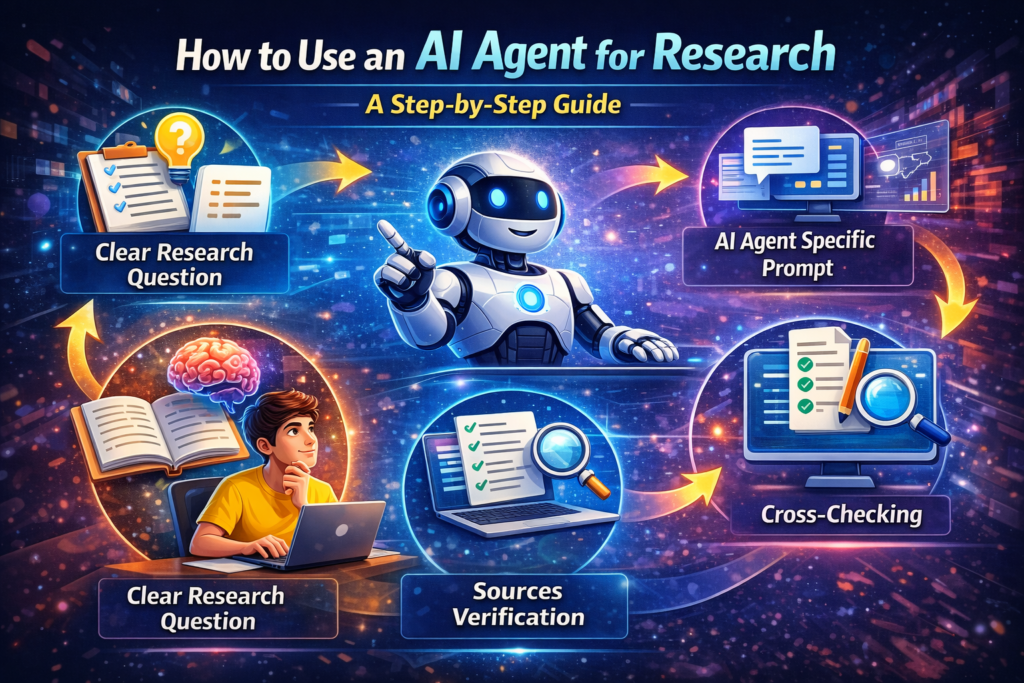
Now for the most practical part—how to use an AI agent for research correctly?
Many people open AI and write just one line:
“Tell me about this topic.”
Then they complain that the answer was basic.
The truth is:
Smart results from AI are achieved when you use it smartly.
Let’s look at a simple step-by-step guide—one even a 15-year-old can follow.
1. Define a Clear Research Question
The first and most important step is clarity.
Wrong way:
“Tell me about AI.”
Right way:
“What is the impact of AI in healthcare? Explain its benefits, challenges, and future scope.”
The clearer your question, the better the output.
An AI agent for research works best when the goal is clear.
Tip:
Keep the topic short.
Specify the time period (e.g., trends for 2024–2026).
Specify the format (summary, report, bullet points).
2. Give the AI agent specific prompts.
Writing prompts is a skill.
Example of a strong prompt:
“Create a 1,200-word structured research report on the impact of social media on teenagers. Include statistics, pros and cons, and a short conclusion.”
This helps the AI agent understand the following:
What the word count should be
What the structure should be
Which points to include
Weak prompts lead to weak output.
Strong prompts lead to strong output.
3. Verify the source
This step should not be skipped.
If the AI provides data that includes:
Numbers
Research results
Statistics
Verify them on a reliable website.
Examples:
Government website
Official report
Accredited institution
The AI agent for research is an assistant, not the final judge.
Verification will make your content Google E.E.A.T.-friendly.
4. Cross-check
Don’t rely on a single tool.
You can:
You can use two different AI tools.
Or combine AI and Google search.
If you find the same information in both places, it’s more likely the data is reliable.
This habit makes you a smart researcher.
5. Adopt a human mindset (most important)
The biggest mistake is copying and pasting.
The AI’s output is not a final draft—
it’s a starting point.
You should:
Rewrite in your own words
Add your opinion
Add real-life examples
Check the logic
This is the difference between a smart user and a normal user.
AI Agent for Research doesn’t replace your brain—it supports it.
Remember the simple formula:
Clear questions + strong prompts + verification + cross-checks + human thinking
= smart research
If you follow these 5 steps, AI Agent for Research can become a powerful productivity tool for you—whether you’re a student, blogger, or business owner.
Real Case Study
How I Used an AI Agent for Research to Write a 2000-Word Blog in 2 Hours
So far, we’ve been understanding the theory.
Now, let me give you a practical example—in a real workflow style—so you can clearly understand how AI Agent for Research actually helps.
This is an honest, experience-based explanation, in which I’ll walk you through step-by-step how I completed a 2,000-word blog in just 2 hours.
Step 1: Define a Clear Goal
My topic was:
“Impact of AI on Small Businesses in 2026”
What did I normally do before?
Google search
15–20 articles open
Making notes
Decide on the structure
This process used to take 3–4 hours.
This time, I decided to use AI Agent for Research directly.
Step 2: Give Strong Prompt
I did not give a simple prompt.
I clearly wrote:
“Create a detailed outline for a 2000-word blog on the impact of AI on small businesses in 2026. Include statistics, benefits, challenges, and future trends.”
Result?
I got a structured outline within minutes:
Introduction
Current AI adoption
Benefits
Risks
case examples
Future outlook
Conclusion
Here I saved 40–50 minutes of planning time.
Step 3: Deep Research Mode Used
Then the main AI Agent for Research said:
Identify latest trends with
Small business examples do
By explaining real-world use cases
Agent ne:
Automation examples diy
Mentioned AI marketing tools
Productivity improvement explained
Everything was found in organized format.
Step 4: Verified
This was the important part.
I:
Verified important data on Google
Checked official company websites
Cross-checked 1-2 statistics
This gave me confidence that the content was reliable.
This step is very important for Google E.E.A.T.
Step 5: Added the Human Touch
The most important step.
I:
Added my opinion
Added local business examples
Rewrote in simple language
Made complex sentences easy
Result?
The article didn’t feel robotic.
Maintained a human tone.
Final Result
Normally:
Takes 4–5 hours
Mentally exhausted
This time:
Complete in 2 hours
Structure clear
Data organized
Flow smooth
And most importantly:
I didn’t blindly copy and paste.
I used the AI Agent for Research as an assistant, not as a writer.
Honest Learning
This experience taught me three important things:
Clear prompt = better output
Verification is mandatory
AI content is incomplete without human editing
If you use the AI Agent for Research smartly, you can:
Save time
Quality can improve
Productivity can double
But if you just copy and paste, long-term growth is impossible.
Simple Takeaway
An AI agent for research isn’t a shortcut.
It’s a smart assistant that saves you time—but the final thinking is yours to do.
Future of AI Research Agents
Now, the most exciting question—
What will the future hold for AI agents for research?
The AI research tools we use today are just the beginning. In the coming years, these tools could become even more intelligent, independent, and powerful.
Let’s explain four major changes of the future in simple language.
1. Autonomous Agents (AI that works on its own)
So far, we give instructions to AI, and then it acts.
Future AI Agents for Research:
Can create a research plan on their own
Can identify subtopics related to a topic
Can automatically update data
Can prepare reports based on deadlines
Meaning you simply set the goal—
and the AI will manage the entire research workflow.
Example:
You say:
“Every week I need a report on the latest trends in the AI industry.”
Future AI Agents:
Collect data every week
Compare changes
Send an automatic summary
This will be true automation.
2. Research Automation (Manual Work Will Be Reduced)
In the future, AI agents for research will not only create summaries, but will also:
Perform data visualization
Create charts
Highlight key insights
Remove duplicate information
The boring parts of research will almost be automated for both students and professionals.
But importantly:
The value of human thinking will not diminish—it will become more important.
3. Academic Transformation
Major changes could occur in the education sector.
In the future:
Students will be able to take personalized research notes from AI.
Complex topics will be explained in simple language.
Literature review processes will be faster.
Teachers will be able to use AI support for research guidance.
But schools and colleges will also need to establish ethical rules—so that students don’t just copy and paste.
If used correctly, AI agents for research can make learning faster and smarter.
4. The Next Level of Business Intelligence
Data is the most powerful thing in the business world.
In the future, AI research agents will:
Automatically track market trends
Monitor competitor activities
Analyze customer behavior
Predict risks
This means:
Decision-making will become faster.
Developing data-driven strategies will become easier.
Even small businesses will be able to perform advanced research—something previously only big companies could afford.
Simple Future Vision
In the next 5–10 years, AI agents for research will:
Be more independent
Be more accurate
Be more personalized
And become a normal part of daily workflows.
But one thing is clear:
AI research agents will not replace human intelligence.
They will upgrade human intelligence.
Final Thought (Easy Language)
Imagine if you were a 15-year-old student and learned to use AI tools correctly today—
then in the future you could be 10 steps ahead of others.
Technology rewards those who understand and use it.
Conclusion
AI Agent for Research is a powerful tool—but it’s not magic.
It saves you time, organizes information, and speeds up the research process. But the final decisions, verification, and thinking always fall on you.
If you use AI as a shortcut, growth will be limited.
If you use AI as a smart assistant, both your learning and productivity will improve.
The future belongs to those who understand and use technology.
Start using AI Agent for Research smartly today—and take your research skills to the next level.