
1. Introduction – What is Generative AI? (Simple and Relatable)
Imagine a computer that doesn’t just perform calculations or store data…
but can also write stories.
Imagine you say to it:
“Write an inspiring story about a boy from a small village.”
and it instantly creates a complete story.
Or you say:
“Create an image of a future city,”
and without a camera or a painter, it creates a new image.
Or you write:
“Create sad romantic music,”
and the background music is ready in seconds.
This is generative AI.
“AI is no longer limited to just providing answers; now AI also creates.”
Generative AI in simple terms:
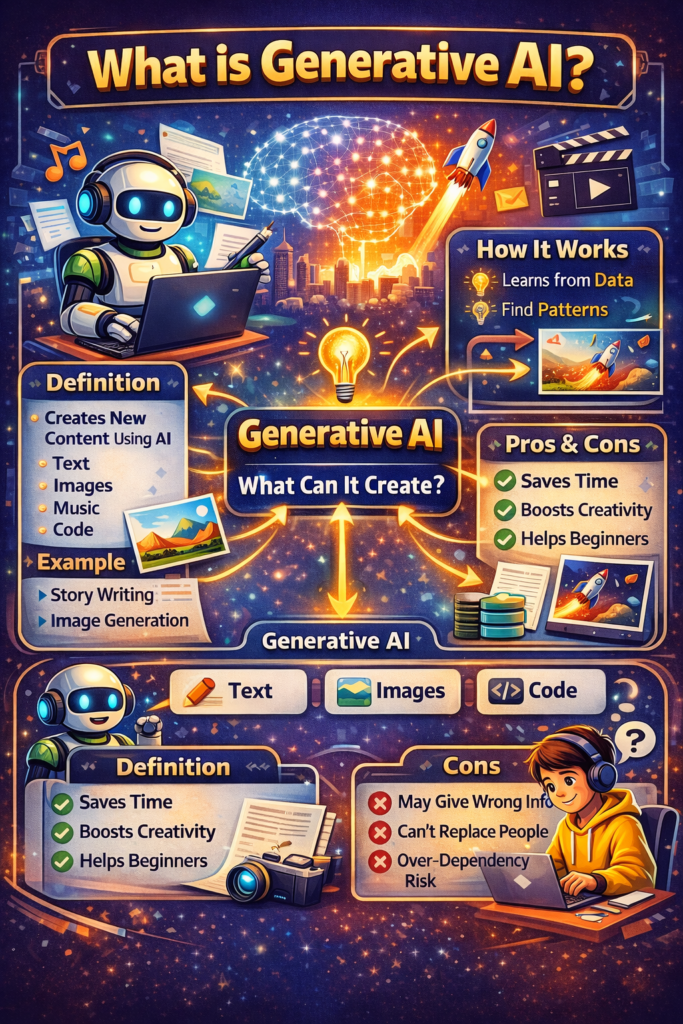
Generative AI is an artificial intelligence technology that creates new content.
It doesn’t just search for information—
it writes, creates, designs, and generates itself.
Content can mean:
Text (blogs, stories, scripts)
Images (art, logos, product photos)
Music
Video
Code
For example, ChatGPT generates text, and DALL·E generates images. These tools demonstrate how powerful generative AI has become.
In simple terms:
Generative AI is a digital creator.
Real-life example (which you’re already seeing)
If you use social media, you’ve likely seen photos created by AI.
Or heard an AI voice-over on YouTube.
Or even used captions written by AI.
Generative AI is also being used in the business world:
Companies are writing product descriptions
Designers are getting ideas from AI
Students are taking notes
Bloggers are creating outlines
When I’m planning content, I first use generative AI for idea brainstorming. But I always use human editing for the final touches—because human emotion and authentic experiences are paramount. (This is also crucial for Google E.E.A.T.)
Why is generative AI so trending in 2026?
By 2026, the world will be faster. People need speed.
Fast content
Fast design
Fast business setup
Fast learning
Generative AI accelerates all of these things.
The main reasons it’s trending:
Saves time
Empowers beginners to be creative
Reduces business costs
Expands freelancing opportunities
Makes the learning process easier for students
The biggest reason?
AI is no longer just for tech experts.
Even a 15-year-old student can create content by typing a simple prompt.
And because of this, generative AI isn’t just a technology—it’s become a digital revolution.
A final thought from the introduction
If you’re using the internet today, chances are you’ve interacted with generative AI content somewhere.
The only difference is—
Some people are just watching.
and some are using it to grow.
What is generative AI? (Definition in Simple Words)
Simply put, Generative AI is an artificial intelligence system that creates new content.
It doesn’t just copy information from the internet, but creates something new based on the data it learns.
This means that Generative AI acts like a digital creator.
Simple Definition
Generative AI is an AI technology that can:
Write text
Create images
Create videos
Create music
Write code
And all of this based on a single instruction (prompt).
Let’s put it simply:
Imagine you say to a computer:
“Write me a short motivational story.”
Older software might provide a saved template.
But Generative AI will write a completely new story for you—one that never existed before.
Similarly, if you say:
“Create an image of a lion standing in the jungle wearing sunglasses.”
AI will create a unique image based on your description.
This isn’t magic.
It’s the result of a smart learning system.
Real-world example
Many companies around the world are working on generative AI today.
For example:
OpenAI – which develops advanced AI models
ChatGPT – which generates text and provides creative answers to questions
DALL·E – which can create images from descriptions
But remember, these tools are just examples.
The concept of generative AI is much broader than this.
Does generative AI copy or create?
This is an important question.
Many people think that generative AI simply copies and pastes.
But the reality is that it generates new content by understanding patterns.
Just as a student reads 100 stories and then writes their own, generative AI learns from data and then creates new output.
Simple Comparison
Normal calculator:
Will only perform calculations.
Search engine:
Will only find information.
Generative AI:
Will create new content.
This difference is what makes this technology powerful.
Why is it important to understand?
In today’s digital world, generative AI isn’t just a trend.
It’s the skill of the future.
Whether you’re a student, blogger, business owner, or freelancer —
Generative AI can make your work faster and more creative.
And the best part?
You don’t need to be a coding expert to use it.
All you need is the right mindset, clear instructions, and a little practice.
How does generative AI work? (Easy step-by-step explanation)
Now the most important question—how does generative AI work?
Does it really “think”? Or does it just guess?
Let’s understand this very simply—step by step.
Step 1️⃣: AI is given lots of data
First, generative AI is trained.
Training means it is shown lots of data.
For example:
Books
Articles
Conversations
Images
Code examples
Just like a student learns more the more they read.
Similarly, generative AI understands language and patterns by looking at examples.
Important:
It doesn’t memorize data word-for-word.
It understands patterns.
Step 2: AI learns patterns
This is the most powerful stage. Generative AI looks at:
Which word comes after which other word?
How is a sentence formed?
How does a story progress?
What is the relationship between colors and shapes in an image?
For example, if AI has seen thousands of motivational quotes, it will understand what common words they contain:
“success,” “hard work,” “dream,” “never give up,” etc.
It’s like watching Bollywood movies and understanding what might happen in the climax.
Step 3: User Input (Prompt)
Now comes the most important concept—the prompt.
“Prompt” means:
The instruction you give to AI is
In simple terms:
Prompt = your question or instruction.
Example prompt:
“Write a motivational quote about success.” Now, here you are given clear instructions:
What is the topic (success)
What is the format (motivational quote)
The clearer the prompt,
the better the output.
So, the results of generative AI depend 70% on the prompt.
Step 4: AI generates new content
Now, based on its training and patterns, the AI creates entirely new output.
A possible output for the above prompt might be:
“Success doesn’t come by luck; it comes by having the courage to try again after every failure.”
This line may not have existed in its exact form before. But the AI combined the learned patterns to create this new sentence.
This is the real magic of generative AI—
learning + understanding patterns + prompt = new content.
A simple real-life Example:
Imagine you’re in a drawing competition.
You’ve seen many drawings before (training data).
You’ve understood the style (pattern learning).
The teacher gave the topic—”Draw a city of the future” (prompt)—.
You created a drawing from your imagination (generation).
Essentially, generative AI does something similar—
but at a much faster speed and on a larger scale.
Does generative AI think?
This is also important to clarify (to be honest, it’s important for E.E.A.T.).
Generative AI doesn’t think like humans.
It doesn’t have emotions or personal experience.
It simply chooses the most appropriate next word, image, or sound based on mathematical patterns and probability.
But when the results come in,
They look like humans.
Final Summary (in simple terms)
The way generative AI works is simple:
Learns from data
Understands patterns
Takes prompts from users
Creates new content
So if you learn to use generative AI smartly,
You can:
Write faster
Generate creative ideas
Grow your business
And most importantly—
You’ll be prepared for the digital world of the future.
Real-Life Examples of Generative AI
By now, we understand what generative AI is and how it works.
Now for the most interesting part—where is it being used in real life?
Frankly, you see the results of generative AI in some form or another every day, but you probably don’t realize it.
Let’s look at a simple and straightforward example.
Text Generation (Written Content)
This is the most popular use of generative AI.
Blog Writing
Bloggers use AI to create outlines, headings, and drafts. This saves them time and clarifies their ideas.
Story Writing
Students or writers create short stories, scripts, and creative content.
Email Drafting
AI helps you write professional emails, job application emails, or marketing emails.
If you’re a content creator, generative AI helps you avoid the problem of a blank page. But final editing is best done with a human touch—this is important to remember (authenticity is essential for E.E.A.T.).
Image Generation
These days, images can be created without a camera or designer thanks to generative AI.
Logo Design
Small businesses generate logo ideas with the help of AI.
Product Images
E-commerce sellers can create creative background images for their products.
Social Media Graphics
Instagram posts, YouTube thumbnails, posters—all can be designed with AI.
This is a powerful tool for beginners, as creativity is no longer limited to designers.
Music Creation
It sounds a bit futuristic, but it’s true.
Background Music
YouTubers create copyright-free background music for their videos.
AI Singing
Some tools can even create songs from AI voices.
All of this is possible thanks to generative AI.
But in the professional music industry, human creativity still plays a vital role.
Code Generation (Helps with Programming)
If you’re learning programming, you’ll find this part interesting.
Website Code
AI can generate basic code for HTML, CSS, and JavaScript.
App Development
Developers use AI tools to create sample code for app features.
Here’s a popular example:
GitHub Copilot—which provides developers with real-time coding suggestions.
This tool was developed on GitHub’s platform.
But remember:
AI suggests code; the ultimate responsibility lies with the developer.
Testing and security checks must be performed by humans.
Final Thought
From all these examples, it’s clear that generative AI isn’t just an experiment.
It’s already becoming a part of education, business, freelancing, and content creation.
Most interesting?
Even a 15-year-old student can use AI for:
Writing essays
Designing posters
Building basic websites
This means creativity is no longer limited—
If you learn to use generative AI correctly, you can go far in the digital world.
5 Generative AI Tools You Should Know (Beginner-Friendly List)
If you want to use generative AI practically, knowing the theory isn’t enough. You also need to know the tools. Below, I’m listing beginner-friendly generative AI tools that even a 15-year-old can easily understand and use.
Text Tools (For Creating Written Content)
1️⃣ ChatGPT
This is a popular generative AI tool that creates text.
You can use it for:
Writing blogs
School essays
Story ideas
Email drafting
Writing YouTube scripts
You simply write a prompt in simple language, and it gives you structured and readable content.
But remember—final editing and fact-checking must be done by a human (required for E.E.A.T.).
2️⃣ Gemini
This is Google’s generative AI-based chatbot.
It’s helpful for:
Research
Quick explanations
Note taking
If you’re a student, it acts as a learning assistant.
Explains simple questions in simple language.
Image Tools (for creating images and designs)
3️⃣ Midjourney
This is an advanced generative AI image tool known for creating creative and artistic images.
It’s used for:
Fantasy art
Digital posters
Concept design
Creative illustrations
If you’re a social media creator, this could be a powerful tool for you.
4️⃣ DALL·E
This tool creates images from text descriptions.
Example:
“A robot is reading a newspaper while drinking tea.”
And the AI will create an image based on that description.
Business owners use it to create product mockups and creative visuals. Video Tools (for creating videos with AI)
5️⃣ Runway
This is a generative AI-based video tool that provides video editing and AI effects.
It’s used for:
Background removal
Creating short AI clips
Video enhancement
Very helpful for YouTubers and content creators.
Important Note (Trustworthy and E.E.A.T. friendly)
These generative AI tools are powerful, but it’s best not to use them without thinking.
Always check the output
Verify the facts
Add your personal touch
Do your own creative thinking
AI is an assistant, not a replacement.
Final Thoughts
If you’re a beginner, start with text tools first.
Then gradually explore image and video tools.
Using generative AI tools correctly will help you:
Create content faster
Start earning money online
Develop freelancing skills
Build your digital brand
In the next section, we’ll look at:
What’s the difference between generative AI and traditional AI—what should every beginner understand?
Generative AI vs. Traditional AI (Understand the Difference)
Many people are confused about the difference between generative AI and normal (traditional) AI.
Are they the same thing?
Short answer: No.
Both are AI, but their functions are different.
Let’s explain this in simple language and table format—so that even a 15-year-old student can easily understand it.
| Feature | Traditional AI | Generative AI |
|---|---|---|
| What does it do? | Analyzes data | creates new content |
| Focus | Decision-making | creation |
| Example | Detecting spam emails | writing stories |
| Output | Yes/No, Prediction | Text, Image, Music, Code |
| Creativity | Limited | High (pattern-based creativity) |
Let’s understand this with an example.
Example 1: Spam Detection (Traditional AI)
When you use Gmail, you may have noticed that some emails are automatically moved to the “Spam” folder.
This is the work of Traditional AI.
What does it do?
Analyzes email data
Checks for suspicious words
Compares past patterns
Then decides: Spam or not spam
It doesn’t create anything new. It just makes decisions.
Example 2: Story Writing (Generative AI)
Now, suppose you tell an AI:
“Write an inspiring story about a student who finds success after failure.”
Now, Generative AI:
Will use language patterns
Will follow story structures
Will create characters
Will create dialogue
Will give you a new story—one that didn’t exist before.
This is the real difference.
Easy Analogy (Real Life Example)
Traditional AI = Security Guard
Job: Checking and deciding
Generative AI = Writer/Designer
Job: Creating new content
Both are important, but the roles are different.
Why is Generative AI being discussed more?
These days, people want to create content for:
Blogging
YouTube
Instagram
Freelancing
Online Business
That’s why Generative AI is becoming more popular, because it’s directly linked to creativity and production.
But this doesn’t mean that traditional AI is useless.
Banking, medical diagnosis, fraud detection—these all rely on traditional AI.
Honest Insight (EEA-T Friendly)
If you’re a beginner, it’s important to understand both concepts.
But if you’re interested in content creation, freelancing, or earning money online, Generative AI is a more relevant skill for you.
Final Summary
Traditional AI:
Analyzes
Predicts
Makes decisions
Generative AI:
Creates
Designs
Generates new content
And that’s why Generative AI has become a powerful creative tool in today’s digital world.
7. Advantages of Generative AI
So far, we’ve understood what Generative AI is and how it works. Now the question arises—what are its benefits? Is it just a trend, or is it truly useful?Let’s understand the simple and practical advantages.
- Saves Time
The biggest benefit is speed.
If you need to create a blog outline, normally you’ll need to:
Research the topic
Think of headings
Plan the structure
This can take 1–2 hours.
But with Generative AI, this task can be done in just a few minutes.
Let me share my real experience:
“I created a blog outline using AI myself in 10 minutes.”
But then I edited it, improved it, and added my own personal touch.
This balance is what makes a smart user.
- Provides Creative Help
Sometimes we get stuck.
We can’t even think of where to start.
This is where generative AI acts as a creative partner.
It suggests new ideas
Generates headlines
Shows different angles
It doesn’t replace you—
but it helps you think.
So think of it as an assistant, not a replacement.
- Empowers Beginners
Previously, if someone had to:
Build a website
Design a logo
Write script
They had to either hire an expert or learn the skill.
Now, with the help of Generative AI, even beginners can get started.
Even a 15-year-old student can:
Create presentation content for a school project
Generate example code for coding practice
Write a creative story
It is making the digital world more accessible. - Useful in Business Automation
Generative AI is a powerful tool for business owners. Example:
Generating product descriptions
Drafting customer support replies
Creating marketing captions
Writing email campaigns
This reduces costs and increases speed.
But importantly—
AI-generated content should always be reviewed.
Maintaining quality and trust is crucial for business (a core point of Google E.E.A.T.).
Honest Perspective (to Build Trust)
Generative AI isn’t perfect.
Sometimes:
Can provide incorrect information
Can generate generic content
Can lack human emotion
So the best results are achieved when:
AI + Human Editing = High Quality Output
Final Thought
In today’s digital age, generative AI is not a shortcut,
but a smart tool.
If you learn to use it correctly, you can:
Grow faster
Explore online earning opportunities
Build your digital brand
And most importantly—
You’re developing future-ready skills.
8️⃣ Risks & Limitations of Generative AI (For Building Trust)
Every powerful technology comes with its own challenges.
Generative AI is no exception.
If you want long-term growth—whether in blogging, business, or studies—it’s important to understand not only the advantages but also the risks. This approach is also important for Google E.E.A.T. (Experience, Expertise, Authoritativeness, Trustworthiness).
Let’s explain it simply and honestly.
1️⃣ It can sometimes give wrong information.
The biggest risk is that generative AI can sometimes give wrong answers in a confident tone.
Because AI doesn’t “understand” like humans.
It simply generates answers based on patterns and probability.
So, if you:
Are seeking health advice
Are studying legal information
Are making a financial decision
Using AI’s answers without verifying them can be risky.
Smart Rule:
Get information from AI, but confirm your final decision with reliable sources or experts.
2️⃣ Cannot Replace Human Creativity
Many people think that generative AI will replace writers, designers, or musicians.
What is Reality?
AI can generate content,
but it requires:
Real-life emotion
Personal experience
Deep storytelling
Cultural understanding
All of this comes from human creativity.
Example:
AI can write a motivational speech.
But a speech written by a human based on their own struggles has a different impact.
Therefore, the best results are achieved when:
AI + Human Creativity = Powerful Content
3️⃣ Overdependence can be a problem
If you start relying on generative AI for every little thing, your own thinking power can be weakened.
Imagine if students:
Had AI do every homework
Had AI write every essay
Had AI not practice thinking on their own
This could diminish the long-term learning effect.
Use AI as a helper,
not as a substitute.
4️⃣ Privacy & Data Concern
When you enter information into an AI tool, you should be careful not to share sensitive data.
For example:
Bank details
Personal passwords
Private documents
Only responsible users are safe to use.
Honest Expert Insight (To Build Credibility)
My personal approach is this:
I use generative AI for idea generation
I use it for drafting
But I always edit the final content
I cross-check facts
It provides speed and maintains quality.
This balanced approach is the only long-term safe strategy.
Final Thought
Generative AI is a powerful tool—
but like every powerful tool, it must be used responsibly.
Remember:
Verify information
Add your human touch
Don’t blindly trust
Continue the learning process yourself
9️⃣ The Future of Generative AI (2026 and Beyond)
Those who use generative AI intelligently and smartly
will achieve sustainable success in the future.
If you think that Generative AI is just a trend that will disappear in a few years, you’re probably wrong.
After 2026, the world is going to become even more digital.
And a strong pillar of this digital world will be Generative AI.
Let’s take a visionary look at its role in the future.
1️⃣ AI in Education
Future classrooms may be different from traditional classrooms.
Generative AI:
Can provide personalized notes to students
Can explain difficult topics in simple language
Can generate practice questions
Can help with language translation
Imagine if every student had a digital tutor who would teach at their pace and level.
But a balance is essential here.
AI will help, but real learning will happen when students practice on their own.
2️⃣ AI in Business
Generative AI has already entered the business world, but its role will only grow in the future.
Possible changes:
Automated marketing campaigns
Personalized product recommendations
AI-based customer support
Faster product design ideas
Small businesses that previously struggled due to limited budgets
will now be able to create professional content with the help of AI tools.
But trust and authenticity will be the most important factors in the future.
Companies will have to clearly state whether content is AI-assisted or fully human-created.
3️⃣ AI Jobs
Most common question:
“Will Generative AI take jobs?”
Reality is a bit more nuanced.
Yes, some repetitive jobs can be automated.
But new jobs will also be created, such as:
AI Prompt Engineer
AI Content Editor
AI Trainer
AI Ethics Specialist
In the future, demand will be for those who understand and can use Generative AI—
not those who ignore it.
Skills will change, but opportunities won’t disappear.
4️⃣ In AI Content Creation
Blogging, YouTube, Instagram, Podcasting—
Generative AI’s impact is going to increase everywhere.
In the future:
Faster script writing
AI-generated visuals
Voice cloning
Hyper-personalized content
But one important thing:
As AI content grows,
so will the value of human authenticity.
People will place greater importance on original experiences and real stories.
Therefore, the winner of the future will be the one who:
Combines AI + Human Experience.
Vision 2030: The Role of Generative AI
Moving forward, Generative AI will:
Be part of smart assistants
Become a personalized learning system
Become a business growth accelerator
Become a co-pilot of the creative industry
But rules, regulations, and ethical guidelines will also be strengthened.
Technology will grow,
but responsibility will also grow.
Final Visionary Thought
Generative AI will not replace the future—it will reshape it.
Those who begin to understand this skill as early as 2026
can establish a strong position in the digital world by 2030.
If you’re a student, a content creator, or want to start a business —
then understanding Generative AI is no longer an optional skill,
it has become a future-ready skill.
🔟 Can you earn money with Generative AI?
Short answer: Yes, you can.
But not just by using the tool—by using it smartly.
In today’s digital world, Generative AI is not only a tool for creativity, but also a earning opportunity. If you’re a student, a beginner, or want to create your own online income source, this section is important for you.
Let’s look at practical ideas.
1️⃣ Freelancing
Both speed and quality matter in freelancing.
Generative AI helps you work faster here.
What services can you offer?
Blog writing
Social media captions
Email copywriting
Basic website content
AI-assisted graphic ideas
Important:
Clients want high-quality output. So have AI create a draft, then give it a human touch. This approach makes you professional.
2️⃣ Blogging
If you want to start your own blog, Generative AI can help you with:
Topic research
Outline creation
SEO-friendly headings
F.A.Q. section generation
But AI content alone isn’t enough for Google ranking.
You’ll need to add your experience, real examples, and honest opinion.
AI provides speed.
Growth provides your strategy.
3️⃣ YouTube Script Writing
Competition on YouTube is high these days.
Writing a regular script isn’t easy.
With Generative AI, you can:
Generate script ideas
Create hook lines
Write structured scripts
Create quick content for shorts
If you’re camera shy, you can also earn money by offering script writing services.
4️⃣ Affiliate Marketing
In affiliate marketing, you promote products and earn commissions.
Generative AI helps here:
Writing product reviews
Creating comparison articles
Creating email marketing drafts
Generating landing page content
But building trust is most important.
Making false or fake claims will prevent long-term success.
5️⃣ AI Image Selling
If you’re creative, you can use generative AI image tools to:
You can create unique digital art.
You can design social media templates.
You can create posters or print designs.
You can sell them on online platforms.
But keep in mind:
It’s important to understand copyright rules and platform policies.
Realistic Advice (E.E.A.T. Friendly)
It’s possible to make money with generative AI, but becoming rich overnight isn’t realistic.
You need to:
Develop skills
Maintain consistency
Understand market demand
Build your personal brand
AI is just an accelerator.
You are the driver.
Final Motivation
Today, even a 15-year-old student can:
Start a blog
Offer scriptwriting services
Create AI images
And gradually build an online income.
Generative AI is an opportunity.
But success will only come to those who learn, practice, and use it responsibly.
Conclusion
We’ve seen that generative AI isn’t just a trend, but a powerful digital tool that can create text, images, videos, and ideas.
Remember:
“Generative AI is a tool. Those who use it will thrive.”
If you want to be future-ready, then:
Start learning AI today
Practice daily prompts
Stay updated on new AI tools
Use generative AI smartly—and take your growth to the next level.