
1. Introduction
The digital world is rapidly evolving, and as a writer, blogger, or marketer, keeping up with content demands can sometimes feel overwhelming. That’s where AI writing tools come in. In 2026, these tools are no longer just fancy gadgets—they’ve become intelligent assistants that help us create content faster, more creatively, and often with better structure.
I remember spending hours staring at a blank page, struggling to find the right words. Today, using AI writing tools has completely transformed my workflow. A simple prompt can generate multiple blog intros, social media captions, or even long-form articles in minutes. But what truly impressed me is that these tools don’t just increase speed—they offer ideas I might not have considered on my own.
In this blog post, I’ll share the 10 best AI writing generators of 2026 that I’ve personally explored and tested. We’ll look at how each tool works, what makes it unique, and how it can truly streamline your writing process without sacrificing the human touch. If you’ve been curious about AI content creation but weren’t sure where to start, this guide is for you.
By the end, you’ll have a clear understanding of which AI writing tool is right for your style, goals, and workflow—whether you’re a budding blogger, a seasoned marketer, or simply someone who wants to save time while creating high-quality content.
2. What Makes a Great AI Writing Tool in 2026?
Not all AI writing tools are created equal. When I first started exploring them, I quickly realized that some tools produce generic, robotic-sounding content, while others feel almost like having a human co-writer sitting next to you. Over time, I’ve learned that a “great” AI writing tool isn’t just about speed—it’s about quality, adaptability, and usefulness in real-world writing scenarios.
Here are some key factors that make an AI writing generator truly exceptional in 2026:
1. Human-Like Writing Quality
A good AI tool should produce content that sounds natural. You shouldn’t have to spend more time editing the AI output than you would writing it yourself. The best tools understand context, tone, and nuance. For example, some tools can easily switch between casual and professional tones, which is incredibly useful when writing for different audiences.
2. Speed Without Sacrificing Creativity
Yes, AI can generate content quickly—but the best tools also enhance your creativity. I’ve found myself brainstorming ideas with AI that I never would have thought of on my own. It’s like having a writing partner who never runs out of ideas, but still lets you guide the narrative.
3. SEO and Optimization Features
For bloggers and marketers, SEO matters. A tool that suggests keywords, headings, or meta descriptions while generating content saves hours of research. Personally, I prefer tools that don’t just fill the page but also help my content rank better on Google.
4. Customization and Flexibility
Every writer has a unique style. Top AI writing generators let you adjust the tone, length, format, and even the audience type. This flexibility ensures your content feels personal, not machine-generated. For example, I can instruct the AI to write in a friendly, conversational tone for my blog and then switch to a formal tone for client reports—all with the same tool.
5. Ease of Use
A clunky tool can kill productivity. The best AI writing generators in 2026 have intuitive interfaces, easy navigation, and helpful templates. If you’re like me and not very tech-savvy, a simple, well-organized tool makes a huge difference.
6. Reliable and Accurate
AI is smart, but it can make mistakes. Great tools offer fact-checking options, citation suggestions, or allow you to easily review AI-generated content. You’ll still need to use your own judgment, but these features increase confidence that your content is accurate and reliable.
In short: A great AI writing tool is like a reliable co-writer who can brainstorm, draft, and optimize content while respecting your voice and style. When choosing a tool, consider quality, creativity, SEO support, flexibility, usability, and accuracy.
With these criteria in mind, you’ll be ready to explore the 10 best AI writing generators of 2026, which I’ve personally tested and ranked based on real-world performance, not just hype.
3. The 10 Best AI Writing Generators in 2026
By 2026, AI writing tools have significantly improved. Based on my personal experience, these tools not only increase speed but also enhance content quality, creativity, and workflow efficiency. Here, I’m sharing the 10 best AI writing generators of 2026 that I’ve tested and found useful for real-life writing.
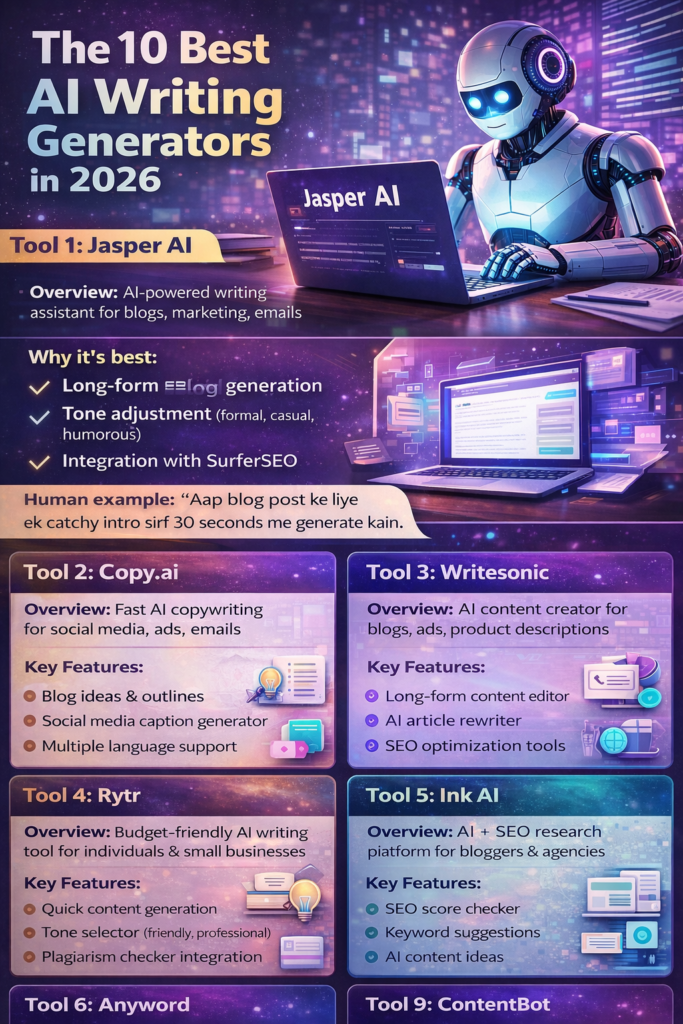
1. Jasper AI
Overview: Jasper AI is a popular AI writing assistant used for blogs, marketing content, emails, and social media.
Why it’s the best: When I used Jasper, I was most impressed by its long-form content capabilities. This AI generates human-like sentences and offers multiple tone options, such as casual, professional, and humorous.
Key Features:
Long-form blog writing
SEO-friendly content integration
Multiple tone and language options
Templates for emails, ads, and social posts
Personal Tip: “I completed the first draft of a client blog in 30 minutes, a task that previously took 3 hours.”
2. Copy.ai
Overview: Copy.ai is a marketing-focused AI tool perfect for quick content creation and brainstorming.
Why it’s the best: If you need social media captions, ad copy, or email content quickly, Copy.ai’s workflow is incredibly fast.
Key Features:
Blog idea generation
Social media caption generator
Support for multiple languages
Ready-made templates for marketing campaigns
Personal Tip: “I found this tool most helpful for generating creative captions for Instagram and LinkedIn.”
3. Writesonic
Overview: Writesonic is an AI content generator that strikes a balance between creativity and factual accuracy.
Why it’s the best: This tool not only creates engaging content but also provides suggestions for SEO-friendly blogs and articles. Key Features:
Long-form content editor
Article rewriting and expansion
SEO keyword suggestions
Multiple content formats: blogs, emails, ads
Personal Tip: “I found its article rewriting feature most useful, making existing content fresh and engaging.”
4. Rytr
Overview: Rytr is an affordable and beginner-friendly AI writing tool.
Why it’s best: Perfect for budget-conscious writers and small businesses. It allows you to adjust the tone, language, and content length.
Key Features:
Fast content generation
Multiple tones: friendly, professional, funny
Plagiarism checker integration
Support for multiple languages
Personal Tip: “I used Rytr for my personal blog, and its simple interface significantly reduced the stress of writing.”
5. Ink AI
Overview: Ink AI is a combined writing and SEO optimization tool.
Why it’s best: Ideal for bloggers and marketers as it generates content and also provides SEO scores and keyword suggestions.
Key Features:
SEO score checker
Keyword suggestions
AI content ideas
Long-form content creation
Personal Tip: “Ink AI’s SEO suggestions improved my blog post rankings without any extra manual effort.”
6. Peppertype.ai
Overview: Peppertype.ai is an AI copywriting tool designed for marketing teams.
Why it’s best: The combination of speed and quality is perfect, and the marketing templates are very useful.
Key Features:
Product description generator
Social media content generator
Blog intros and outlines
Support for multiple languages
Personal Tip: “Creating product descriptions now takes 5 minutes instead of 30 minutes.”
7. Scalenut
Overview: Scalenut is an AI + SEO research platform, ideal for agencies and content creators.
Why it’s best: Research and writing both come together in one platform, which streamlines the workflow.
Key Features:
AI research assistant
Long-form blog generation
SEO insights and keyword analysis
Competitor content analysis
Personal Tip: “I found the research + writing combination most helpful, which would have been tedious to do manually.”
8. Anyword
Overview: Anyword AI creates data-driven content for marketing campaigns.
Why it’s best: With predictive performance scoring, it excels in ad copy and audience-targeted content.
Key Features:
Predictive performance scoring
Ad copy generator
Audience-specific content suggestions
Multi-format writing support
Personal Tip: “I found that Anyword’s predictive metrics helped improve the conversion rate.”
9. ContentBot
Overview: ContentBot is a customizable AI writing tool for startups and marketers.
Why it’s best: Beginner-friendly and ideal for fast content output.
Key Features:
Blog idea & content generator
Email content generator
AI rewriting tools
Flexible content length & style
Personal Tip: “I used ContentBot for an email newsletter, and the quality of the output was quite consistent.”
10. Sudowrite
Overview: Sudowrite is a creative writing and storytelling-focused AI tool.
Why it’s best: Writers or authors who want creative ideas and human-like storytelling.
Key Features:
Story and novel generator
Sentence enhancer & brainstorming
Plot suggestion & dialogue generation
Human-like writing style
Personal Tip: “Sudowrite gave my story ideas a new direction that I probably couldn’t have imagined myself.”
4. How to Choose the Right AI Writing Tool in 2026
A common mistake I see is people choosing an AI writing tool simply because it’s popular. But honestly, popularity doesn’t mean it’s the right fit for you. In 2026, there are dozens of AI writing tools available, and each is designed for slightly different purposes. Choosing the right tool depends more on your goals than on fancy features.
Here are some practical things I personally follow before choosing any AI writing tool.
1. Be Clear About Your Writing Goals
First, ask yourself a simple question: What do I actually want to write?
If your focus is on blogging, long-form articles, or SEO content, you’ll need a tool that understands structure and context. On the other hand, if you’re writing ads, emails, or social media captions, speed and creativity matter more than length.
In my experience, tools that try to do “everything” often do a few things very well and the rest just okay. So clarity here saves both time and money.
2. Check How Human-Like the Output Is
This is crucial in 2026. Google is smarter, readers are smarter, and robotic content just doesn’t cut it anymore. Whenever I test a new tool, I read the output aloud. If it sounds unnatural or repetitive, I know it’s going to require too much editing.
The best AI writing generators act like a co-writer, not a content factory. They give you a solid draft—but you still get to decide the final voice.
3. Look for SEO Support, Not SEO Stuffing
A good AI tool should help with SEO, not hinder it. I personally prefer tools that suggest keywords, headings, or content structure rather than simply stuffing keywords into every sentence.
Remember, in 2026, SEO is about helpful content, not keyword density. If a tool helps you write naturally while keeping search intent in mind, that’s a win.
4. Ease of Use Matters More Than You Think
Some AI tools are powerful but clunky. If a dashboard feels confusing, you’ll avoid using it—even if it’s “advanced.” I learned this the hard way.
Choose a tool that feels intuitive. If you can create your first draft in 5-10 minutes without watching a tutorial, that’s a good sign.
5. Don’t Overlook Budget and Scalability
Not everyone needs the most expensive plan. If you’re a new blogger or a solo creator, starting with a simpler tool is perfectly fine. You can always upgrade later as your content needs grow.
In my opinion, the right tool is one that grows with you, not one that breaks the bank from the start.
Final Advice
There’s no single “perfect” AI writing tool for everyone. The real magic happens when you combine your insights, experience, and voice with the speed of AI. That’s why understanding your needs is more important than chasing trends.
Once you know what to look for, exploring the 10 best AI writing generators in 2026 becomes much easier and much smarter.
5. Final Thoughts: Are AI Writing Tools Worth Using in 2026?
After working with multiple AI tools over time, one thing is clear to me—AI writing tools are not shortcuts, they are support systems. In 2026, the tools included in The 10 Best AI Writing Generators in 2026 are powerful enough to save hours of work, but they still need human thinking to create content that truly connects with readers.
AI can help you generate ideas, structure content, and speed up the writing process. But it cannot replace your experience, judgment, or personal voice. In fact, the best results come when you treat AI as a smart assistant rather than a replacement writer. I’ve seen that content performs best when I guide the AI instead of blindly copying what it generates.
Another important thing I’ve learned is this: tools don’t make content great—decisions do. Choosing the right AI writing tool depends on your goals, your workflow, and how much control you want over the final output. A beginner blogger, a marketer, and a creative writer will all benefit from AI, but not in the same way.
If you’re serious about content creation in 2026, learning how to use AI writing tools properly is no longer optional. It’s a skill. And like any skill, the people who adapt thoughtfully will always stay ahead.
In the end, AI writes faster—but humans write smarter. When you combine both, you create content that not only ranks well but also earns trust, engagement, and long-term value.