
Introduction
I remember when I first tried using AI tools for my business—it was exciting, but honestly, a little overwhelming. There were so many options, and everyone was claiming their tool would make my work faster, smarter, and more efficient. At the time, I had no idea which ones would actually be useful. That’s why I spent weeks testing, experimenting, and learning which AI tools truly deliver.
Today, I can confidently say that knowing the best AI tools for business isn’t just a luxury—it’s become a necessity. Businesses that embrace AI can save hours on repetitive tasks, reduce errors in critical processes, and make smarter decisions faster. And the best part? You don’t need to be a tech expert to get started. With the right tools, even small business owners or solo entrepreneurs can leverage AI to gain a real competitive edge.
From automating routine emails to analyzing customer trends, these tools can transform the way we work. But here’s my honest experience: not every AI tool is worth your time. Some overpromise and underdeliver, while others genuinely make life easier. Over the past few years, I’ve tried dozens of options, and some have truly proven to be game-changers.
In this guide, I’ll share the best AI tools for business—the tools that have helped me save time, improve productivity, and grow my business efficiently. Whether you’re a beginner or looking to upgrade your existing workflow, this list will provide you with practical insights and real-world experience to help you make smart decisions.
How AI Tools Can Transform Your Business
When I first started exploring the best AI tools for business, I quickly realized these tools aren’t just about fancy features—they can truly transform the way we work every day. From saving time to making better decisions, AI has the potential to improve almost every aspect of a business. Here’s how:
1. Automating Repetitive Tasks
One of the biggest benefits I’ve experienced is automation. Tasks like sending emails, scheduling social media posts, or generating basic reports can take hours each week. By using AI, I was able to automate my email responses and weekly follow-ups. Honestly, this saved me about 5 hours a week—time I could then spend on strategy and growth instead of repetitive tasks.
I’ve seen many business owners hesitate to adopt AI because they think it’s too complicated, but the truth is, today’s tools are easy to use and integrate. Even small steps like automating reminders or data entry can make a huge difference.
2. Improving Marketing Campaigns
Marketing used to take up a significant portion of my day—writing ad copy, designing graphics, and analyzing performance metrics. With AI, I could quickly generate content ideas, test headlines, and even create simple graphics.
For example, I used an AI-powered content tool to brainstorm blog topics and ad captions. Not every suggestion was perfect, but it gave me a starting point and reduced my brainstorming time by at least 50%. That’s why learning about the best AI tools for business is so important—they don’t replace your creativity; they augment it.
3. Improving Customer Service
Customer service can make or break any business. I started using an AI chatbot to handle basic inquiries and frequently asked questions. This allowed me to provide instant answers to common questions while still personally handling more complex issues.
I learned that balance is key. AI handles repetitive tasks, but humans still provide empathy and a personal touch. For my business, this combination improved response times and customer satisfaction.
4. Data-Driven Decision Making
One of the most underrated ways AI has transformed my work is through data analysis. AI can spot trends and patterns in sales, website traffic, or customer behavior that I might otherwise miss.
For example, I used an AI analytics tool to review my sales data, and it highlighted products that were consistently popular but under-promoted. Acting on these insights significantly increased my revenue. AI doesn’t replace judgment—it provides faster, better insights so you can make informed decisions with confidence.
By focusing on these areas, I realized that the best AI tools for business aren’t just trendy—they’re practical and deliver results. They save time, increase productivity, and allow business owners like me to focus on strategy, creativity, and growth.
Main Categories of AI Tools for Business
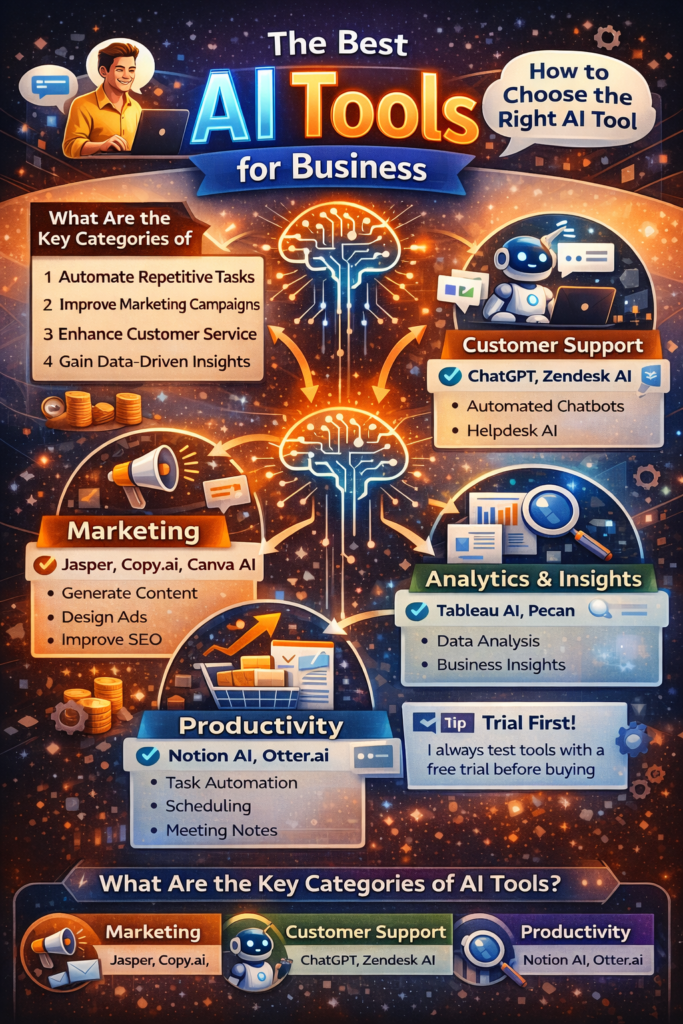
When people search for the best AI tools for business, they often get confused because AI isn’t just one thing. It comes in different forms, and each form solves a different business problem. In my experience, AI works best when you use the right tool for the right job, not when you try to use one tool for everything.
Below are the main categories of AI tools that are actually useful for real businesses.
a) AI for Marketing
Marketing is usually the first area where businesses see quick results from AI. These tools help with content creation, ad design, SEO optimization, and even social media planning.
Popular examples include tools like Jasper, Copy.ai, and Canva AI. I personally tested Jasper for generating blog ideas. To be honest, it gave me a good starting point, but the final content only worked when I added my own experience and tone. AI can speed things up, but it can’t replace your brand’s voice.
In my opinion, AI marketing tools are great for saving time, not for outsourcing creativity. If you use them smartly, they can be some of the best AI tools for business growth.
b) AI for Customer Support
Customer support is another area where AI can make a huge difference, especially for small teams. AI chatbots and helpdesk tools can answer common questions, manage tickets, and provide instant replies.
Tools like ChatGPT and Zendesk AI helped me significantly reduce recurring customer queries. At one point, my support tickets were almost halved. But the truth is, AI can’t handle emotions like humans can. Whenever a customer had a serious problem, personal follow-up was still necessary.
From my experience, the best approach is balance. Let AI handle the basic questions, and let humans handle the trust. That’s how the best AI tools for business truly enhance the customer experience.
c) AI for Productivity
AI-powered productivity tools focus on task automation, scheduling, note-taking, and workflow management. These are especially useful when you’re juggling multiple responsibilities daily.
I’ve used Notion AI for organizing ideas and Otter.ai for transcribing meetings. Otter.ai is great for capturing conversations, but I still prefer quickly jotting down notes myself for clarity. AI saves time, yes—but human thought keeps things meaningful.
In my opinion, productivity AI tools don’t make you smarter. They make you less distracted. And that’s what makes them some of the best AI tools for business operations.
d) AI for Analytics and Insights
This is where AI truly becomes powerful. Analytics tools use AI to analyze vast amounts of data and highlight trends that are easy to overlook.
Tools like Tableau with AI, Pecan, and Zoho Analytics have helped me understand customer behavior and sales patterns more clearly. Once, an AI report showed me which product was performing well but wasn’t being marketed effectively. That insight directly helped improve revenue.
However, I never blindly trust AI data. I always double-check the numbers myself. AI provides direction, but human judgment should always be involved in decision-making. That’s why, when used judiciously, data tools become some of the best AI tools for business decision-making.
Final thoughts on categories
AI tools aren’t magic. They’re assistants. When you understand these categories and choose wisely, the best AI tools for business can save time, reduce errors, and help you scale sustainably without losing the human touch.
My Top 5 AI Tools for Business in 2026
Over the past few years, I’ve tested numerous AI tools – some impressed me, some disappointed me, and some have become an integral part of my daily workflow. This list isn’t based on hype or marketing claims. It’s based on what has actually worked for me in real-world business situations. In my experience, the best AI tools for business are those that save time without sacrificing creativity or control.
Here are my top 5 picks for 2026, along with their honest pros, cons, and how I’ve personally used them.
- Jasper – Best for Content Creation
Uses: Blog content, ad copy, ideas, outlines
Pros:
Very fast at generating ideas
Helps overcome writer’s block
Cons:
Output requires personal editing
Can sound generic if used without thought
My experience:
I’ve primarily used Jasper for brainstorming blog topics and outlines. It gave me a solid starting point, especially on days when ideas weren’t flowing. However, I wouldn’t publish content directly from it. It becomes useful when I add my own experience and tone. For idea generation, Jasper easily earns its place among the best AI tools for business.
- ChatGPT – Flexible Tool for Content and Support
Uses: Customer support replies, emails, content drafts
Pros:
Extremely versatile
Easily adaptable to different tasks
Cons:
Responses can sound generic
Requires clear prompts
My experience:
I’ve used ChatGPT to draft customer emails and support responses. It works great for first drafts and saves a lot of time. However, I always rewrite parts to match my brand’s voice. When used smartly, this is one of the best AI tools for business productivity, not a replacement for human thinking.
- Canva AI – Simple Design and Marketing Tool
Use Cases: Social media posts, banners, presentations
Pros:
Easy for beginners
Designs created in minutes
Cons:
Templates can seem repetitive
Requires customization for branding
My Experience:
Canva AI helped me design social media posts quickly, especially when I was short on time. While it’s not perfect for unique branding, it’s great for quick visuals. For small teams and solo creators, Canva AI is definitely one of the best AI tools for business marketing. 4. Notion AI – Productivity and Organization
Use Cases: Notes, task planning, meeting summaries
Pros:
Organizes information effectively
Improves workflow clarity
Cons:
Requires manual editing
Takes time to learn for beginners
My Experience:
I started using Notion AI for meeting notes and idea organization. It made my work more structured and reduced clutter. However, I still review everything myself. AI organizes, but humans make the decisions. In terms of productivity, it’s one of the best AI tools for business.
- Otter.ai – Accurate Transcription Tool
Use Cases: Meeting and call transcription
Pros:
Fast and mostly accurate
Saves time on manual note-taking
Cons:
Sometimes struggles with accents
Requires review for accuracy
My Experience:
Otter.ai saved me several hours during the week by automatically transcribing calls. I still review the text, but the time savings are significant. For those who frequently attend meetings, this is one of the best AI tools for business operations.
Final thoughts on my top picks
What I’ve learned is simple: AI tools work best when you treat them as assistants, not decision-makers. When chosen carefully, the best AI tools for business can help you work faster, think more clearly, and focus more on growth—without losing the human touch that truly builds trust.
How to Choose the Right AI Tool for Your Business
With so many options available, choosing the right AI tool can feel overwhelming. I’ve been there myself. When I first started looking for the best AI tools for my business, I made the mistake of trying too many at once. Some helped, some didn’t—and some were a complete waste of money. Over time, I learned that the smartest approach isn’t chasing trends, but choosing tools based on genuine needs.
Before investing in any AI tool, I recommend asking yourself a few simple but crucial questions.
- What do I actually need this tool for?
This is the first question I ask every time.
Do you need AI for content creation, design, customer support, analytics, or productivity?
For example, if your main challenge is writing blog posts or marketing copy, content-focused tools will be the right fit. But if customer inquiries are eating up your time, support-focused AI will yield better results. In my experience, the best AI tools for business are always problem-specific, not “one-size-fits-all.”
- How much time will it save me?
AI tools should save time, not create more work. I always think practically—will this tool reduce my workload, or will I have to spend hours learning and refining its output?
Once, I tried a tool that looked powerful but required constant tweaking. I stopped using it within a week. Now, I choose tools that clearly demonstrate time-saving benefits. If a tool can save even 3-4 hours a week, it’s worth considering.
- Can I customize the AI output?
This part is often overlooked, but it’s crucial. Without customization, AI-generated content can feel generic. I always check if the tool allows me to adjust the tone, style, or workflow.
In my opinion, customization is what separates average tools from the best AI tools for business. The more control you have, the more human and brand-friendly the results will be.
- Always Start with a Free Trial (My Personal Rule)
This is a rule I strictly follow. I always take a free trial first. This is how I avoid wasting money on tools I won’t actually use.
A tool might look perfect on the website, but real-world use tells a different story. During the trial, I test it in my daily workflow and ask myself, “Would I pay for this after the trial ends?” If the answer is no, I move on.
- Choose Value, Not Just AI
AI is just technology. What matters is the value. Some tools are simple but effective, while others are advanced but unnecessary for the size of your business.
In my experience, the best AI tools for business are those that seamlessly integrate into your workflow, require minimal effort, and genuinely make your work easier—without replacing your judgment.
Final Thoughts
Choosing the right AI tool is less about features and more about clarity. When you know your needs, test before you buy, and stay realistic, AI becomes a powerful assistant—not an expensive experiment.
Mistakes to Avoid When Using AI in Business
AI can be a powerful support system, but only when used wisely. When I first started experimenting with the best AI tools for business, I made some mistakes that slowed me down instead of helping me. These lessons come from real-world experience, not theory. If you’re using or considering using AI, avoiding these mistakes will save you time, money, and frustration.
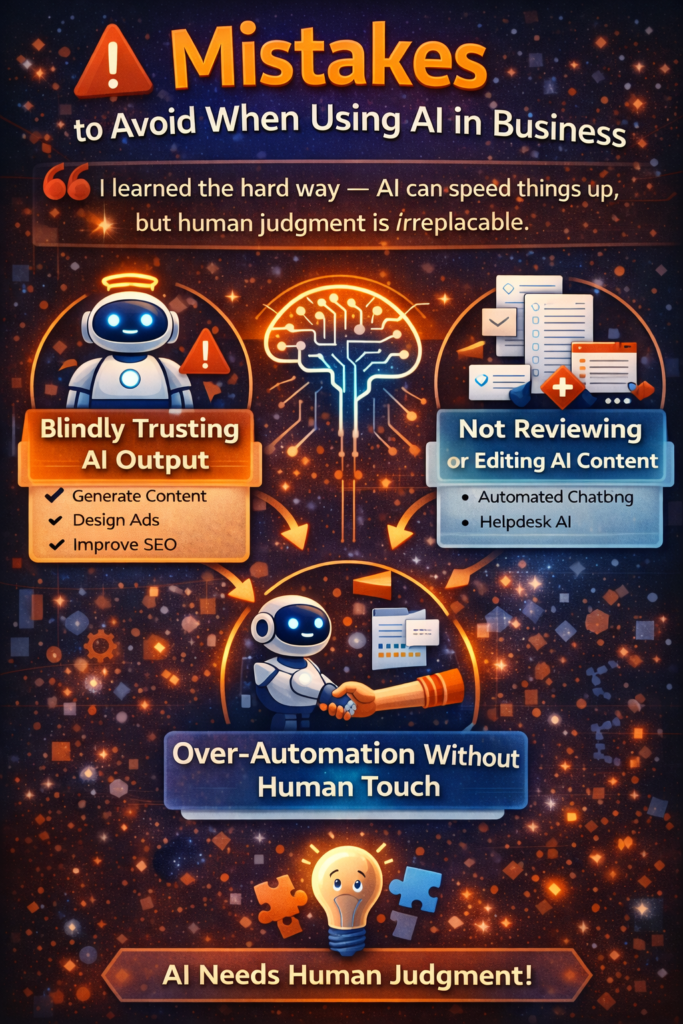
- Blindly Trusting AI Output
This is the most common mistake I see. AI can generate content, suggestions, and insights with great confidence—but confidence doesn’t always equal accuracy.
I’ve personally seen AI generate content that sounds plausible but lacks context or business logic. That’s why I never blindly trust AI output. In my opinion, the best AI tools for business should support your thinking, not replace it.
- Not Reviewing or Editing AI Content
Unreviewed AI-generated content can damage trust. Whether it’s an email, a blog post, or a customer reply, publishing AI output as is is risky.
I made this mistake myself with a customer email draft. The message was technically correct but felt cold and generic. Since then, I’ve made it a habit to always review and edit AI content. A little human touch—tone, emotion, clarity—makes a huge difference.
- Over-Automation Without a Human Touch
Automation is useful, but over-automation can harm relationships. When everything is automated, customers start to feel like they’re interacting with a system, not a business. I learned the hard way—AI can accelerate things, but it can’t replace human judgment. For me, the best AI tools for business are those that handle repetitive tasks while leaving room for genuine human interaction.
- Expecting AI to “fix” business problems
This mistake is rarely discussed. AI cannot fix vague strategies or flawed processes. If your business workflow is broken, AI will only amplify the problems faster.
In my experience, AI works best when you already understand your process. It enhances what’s already working; it doesn’t replace planning or decision-making.
Final Thoughts
AI is a tool, not a shortcut. When used thoughtfully, the best AI tools for business can save time, increase efficiency, and support growth. But when used blindly, they can do the opposite. Balance, review, and human intelligence—that’s the real formula for success.
Conclusion
If I’ve learned one thing from using AI over time, it’s that AI works best when you use it with intention, not just excitement. The best AI tools for business aren’t the most expensive or the most hyped. They’re the ones that quietly save you time, reduce mental overhead, and help you focus on what truly matters.
From content creation and marketing to customer support and productivity, AI can streamline everyday tasks. I’ve seen firsthand how the right tool, used correctly, can transform the way you work. But I’ve also learned that AI can’t replace critical thinking. Your experience, judgment, and personal touch are still the foundation of any successful business.
My honest advice? Don’t try to do everything at once. Start small. Choose one tool that solves your biggest problem right now. Try one AI tool this month and see how it changes your workflow. I truly believe you’ll save time—and probably wonder why you didn’t start sooner.
Ultimately, the best AI tools for business aren’t just about automation. They’re about working smarter, staying human, and building systems that help you grow without burning out.