
1. Introduction
For today’s students, the challenge is no longer limited to merely studying; rather, simultaneously managing multiple assignments, class notes, projects, presentations, and exam preparation on a daily basis has become quite stressful. Whether in school or college, the workload placed upon students has increased significantly compared to the past. Often, despite remaining busy throughout the day, students are unable to revise important topics, and time management emerges as a serious problem.
In this fast-paced digital world, AI tools for students have emerged as a smart support system. Students no longer need to spend hours searching for answers to every minor doubt. AI tools can explain difficult topics in simple language, generate instant summaries, assist in improving grammar, and make study planning much easier.
I have personally observed that while many students put in hard work regarding their studies, they often lack a proper study strategy. Consequently, they experience unnecessary pressure. When utilized smartly, AI tools do not serve as a shortcut for students but rather provide enhanced learning support. These tools can make the learning process faster and more organized—particularly for students who are balancing their academic studies with extracurricular activities or part-time jobs.
In the current era, students are no longer solely dependent on textbooks and traditional handwritten notes. Modern students are leveraging technology to adopt a smarter approach to learning. Whether it involves taking notes, understanding homework assignments, creating presentations, or enhancing exam preparation, various types of AI tools for students are making the entire study process more productive and efficient.
However, it is crucial to understand one important point: the purpose of AI tools is to support learning, not to replace it. Genuine understanding and creativity still stem from a student’s own practice and critical thinking. If utilized in a responsible and intelligent manner, AI can make the learning experience for students easier, faster, and significantly less stressful.

2. What Are AI Tools for Students?
Simply put, AI Tools for Students are smart digital tools that leverage Artificial Intelligence technology to make the study and learning process easier for students. These tools assist students in taking notes, understanding difficult topics, improving grammar, creating presentations, conducting research, and managing their time more effectively.
Previously, students had to search through multiple books or websites to understand a specific topic. However, AI-powered tools can now provide explanations, summaries, and learning suggestions within seconds. For this very reason, AI Tools for Students are becoming an increasingly integral part of the educational landscape today.
How Do Students Use AI Tools?
Different students utilize AI tools for a variety of purposes. Some common examples include:
Generating ideas for homework assignments
Creating quick summaries of lengthy chapters
Improving grammar and writing skills
Designing presentations and projects
Planning for exam preparation and revision
Learning coding and technical concepts
Converting lecture recordings into study notes
I have observed that many students—particularly during exam periods—use AI tools for quick revision and to gain a better understanding of specific topics. If a student finds a particular concept challenging, an AI tool can explain that topic in simple, easy-to-understand language. This makes the learning process less stressful and more interactive.
Will AI Replace Teachers?
This question has become quite common these days. In my opinion, while AI is undoubtedly helpful, it cannot completely replace teachers. Teachers do not merely impart information; they also provide motivation, instill discipline, offer emotional support, and provide real-life guidance. An experienced teacher can better understand a student’s individual strengths and weaknesses—something that AI is currently unable to do fully.
AI tools should be viewed as smart assistants, rather than as replacements. True learning occurs when students actively practice understanding concepts on their own and seek appropriate guidance from their teachers.
Smart Use of AI vs. Cheating
It is crucial to understand the ethical implications here. The smart and responsible use of AI Tools for Students enhances the learning experience, whereas blindly copying and pasting content can be detrimental. What “Smart Use” means:
Using AI to grasp concepts
Improving study planning and note-taking
Seeking writing suggestions
Simplifying difficult topics
Cheating occurs when:
Students directly copy entire assignments
They submit AI-generated answers without understanding them
AI is used to violate exam protocols or academic regulations
For long-term growth, students should utilize AI as a learning aid, rather than as a shortcut. If AI tools are employed in a responsible and ethical manner, they can enhance both students’ productivity and their comprehension.
In today’s digital educational landscape, AI tools can serve as a powerful support system for students; however, true success ultimately remains dependent on consistency, practice, and self-directed learning.
3. Benefits of Using AI Tools in Study
In today’s digital education environment, AI tools for students are no longer just a trend; they have evolved into practical learning support systems. When utilized smartly, AI tools can assist students in better organizing their studies, grasping difficult topics, and managing academic pressure. Particularly for school and college students, these tools are making the learning process faster and more productive.
Listed below are some key benefits that students can experience in their daily academic lives.
Faster Learning
Often, students spend a significant amount of time trying to understand a single topic—especially when the explanation is couched in complex language. This is where AI tools for students make the learning process both easier and faster.
AI tools can explain difficult concepts using simple terminology. If a student struggles to understand Physics numericals, an AI tool can provide a step-by-step explanation. Similarly, Math formulas, coding challenges, or scientific concepts can be broken down and explained in simpler language.
I have observed that when students grasp a topic through visual examples or simplified explanations, both their understanding and their confidence levels improve.
Better Notes
Note-taking is one of the most time-consuming tasks for students. Condensing lengthy chapters and lectures into concise, organized notes is not a feat that comes naturally to every student.
This is where AI tools for students prove to be immensely useful. AI tools can:
Summarize long paragraphs
Highlight key points
Assist in creating quick revision notes
Transcribe lecture recordings into written notes
For instance, if a student has attended a one-hour lecture, an AI tool can help extract the key points from that session. This accelerates the revision process and helps filter out unnecessary information.
Homework Help
Almost every student feels the pressure associated with homework and assignments. At times, students struggle to grasp the underlying concepts behind specific questions, which can lead to frustration.
In such situations, AI tools for students can step in to provide guidance. AI Tools:
Explain questions
Suggest example answers
Provide step-by-step solutions
Offer research ideas
However, there is an important point to note here—the purpose of AI should not be mere copy-pasting. Smart students understand the AI-generated answers and rewrite them in their own words. It is this approach that truly enhances actual learning.
Time Saving
Today’s students manage not only their studies but also projects, online classes, exams, and extracurricular activities. Consequently, time management becomes a major challenge.
AI tools for students accelerate repetitive tasks, thereby saving valuable study time.
AI tools can assist with:
Creating quick summaries
Generating presentation ideas
Organizing research
Planning study schedules
Correcting writing errors
For instance, a task that might manually take two hours can sometimes be completed in just 30–40 minutes with AI support. This allows students to focus more on revision and practice.
Better Writing Skills
Many students struggle with essay writing, grammar, and sentence structure. Their confidence often wavers, particularly when working on English assignments or drafting professional emails.
This is where AI tools for students can aid in improving writing skills. AI tools:
Identify grammatical errors
Enhance sentence clarity
Offer vocabulary suggestions
Recommend better structural organization
I have observed that students who incorporate AI suggestions into their regular writing practice gradually improve their communication skills. However, the final writing style should remain the student’s own; one should not become entirely dependent on AI.
Personalized Learning
Every student possesses a unique learning style. Some students prefer visual learning, others grasp concepts quickly through examples, while some benefit most from step-by-step explanations.
In traditional classrooms, every student is taught using the same method; however, AI tools for students can provide a personalized learning experience. AI Tools:
Provide explanations tailored to the student’s proficiency level
Assist in identifying weak topics
Suggest practice questions
Offer support adapted to the individual’s learning pace
For instance, if a student finds Algebra challenging, an AI tool can initiate practice with easy-level questions and gradually guide them toward advanced levels.
In today’s world, the smart application of AI tools can make the student learning process more organized, interactive, and less stressful. However, true success is achieved only when students view AI as a supportive tool. Use it as a tool, and focus equally on your own understanding and practice.
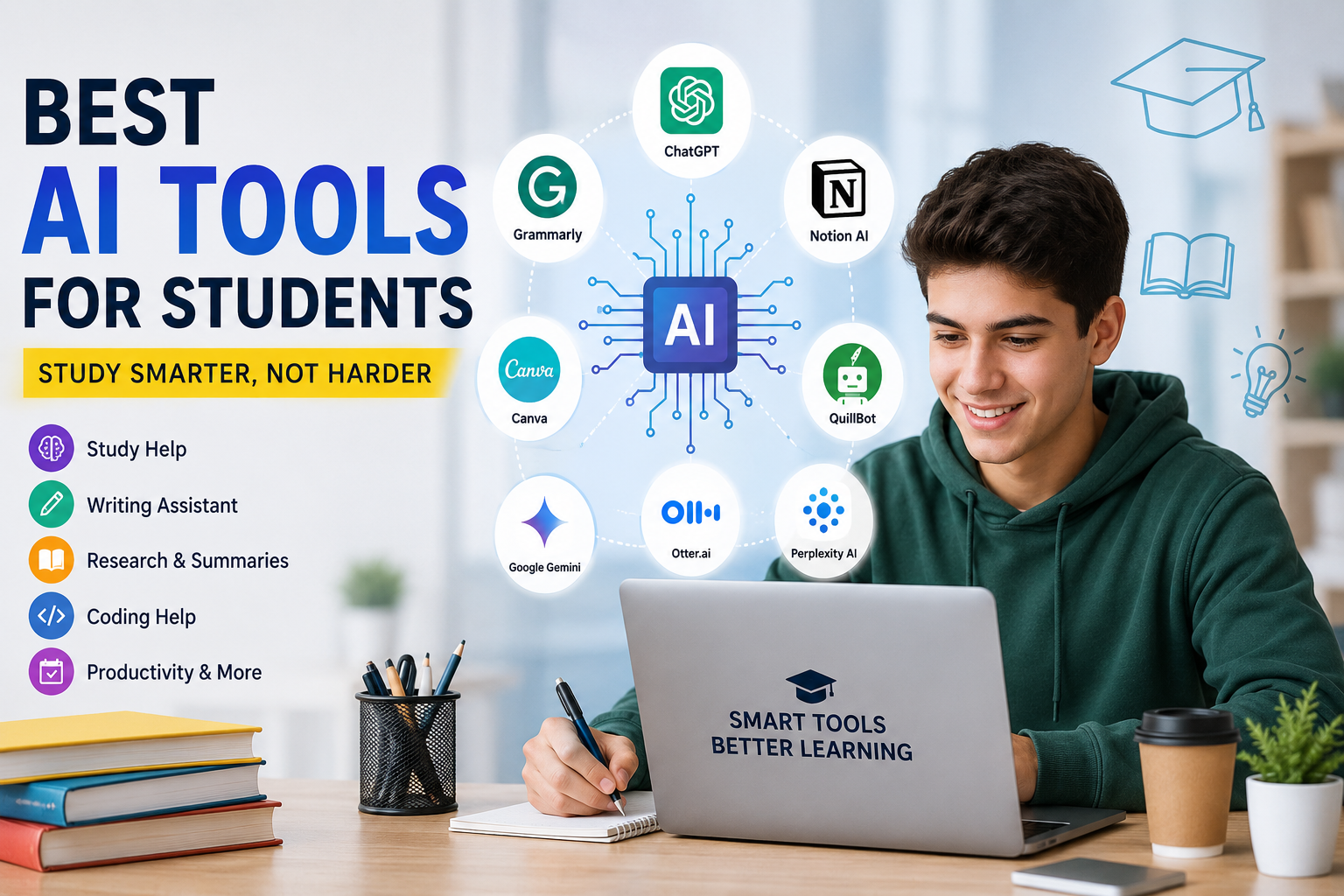
4. Best AI Tools for Students
In today’s digital education environment, different types of AI tools for students are making learning smarter and more efficient. However, each AI tool has a different purpose. Some tools improve writing, some help with research, and some make productivity and study management easier.
I have personally observed that students often start using random AI tools without understanding which tool is best for which purpose. Therefore, the tools below are explained based on practical student needs.
- ChatGPT
What does ChatGPT do?
ChatGPT is an AI assistant that helps students with tasks like:
Homework understanding
Writing help
Topic summaries
Brainstorming ideas
Coding support
Study explanations
It’s especially useful for students who want to understand difficult concepts in simple language.
Which students is it best for?
School students
College students
Coding learners
Content writing learners
Competitive exam aspirants
Free or Paid?
A free version of ChatGPT is available, but advanced features and better models are available in paid plans.
Real Student Use Case
If a student finds a History chapter too lengthy, they can use ChatGPT to understand short summaries and key points. Similarly, coding students can also get debugging help and programming explanations.
Pros
Fast answers
Easy explanations
Multiple subject support
Writing and brainstorming help
Coding assistance
Limitations
May occasionally provide incorrect information
Blind trust can be risky
Direct copy-paste can create academic issues
Human Tip
Don’t copy-paste, rewrite thoughtfully. The best use of AI is to improve learning, not create shortcuts.
- Grammarly
What does Grammarly do?
Grammarly is a writing assistant tool that helps improve grammar mistakes, spelling errors, and sentence clarity.
It’s especially useful for English writing and academic assignments.
Which students is it best for?
Essay writing students
Blog writers
Email writing learners
Assignment creators
Is it free or paid?
Basic grammar correction is available in the free version. Advanced suggestions are available in the premium plan.
Real Student Example
Suppose a student has to submit an English assignment but lacks confidence in correcting grammar mistakes. Grammarly can help improve sentence structure and writing clarity.
Pros
Grammar correction
Better sentence clarity
Professional writing support
Easy browser integration
Limitations
Not every suggestion is perfect
Over-editing can make writing seem robotic
- Notion AI
What does Notion AI do?
Notion AI helps students:
Organize notes
Study planning
Task management
Improve productivity
It functions as a digital study workspace.
Which students is it best for?
Students with organized study planning
Productivity-focused learners
Project management students
Free or Paid?
Basic features are available for free. Advanced AI features are available in paid plans.
Real Student Use Case
If a student has multiple subjects and deadlines, Notion AI can organize daily study schedules and task tracking.
Pros
Clean organization
Study planning support
Productivity improvement
Notes management
Limitations
Beginners may find it a bit confusing initially
Full setup takes time
- Canva AI
What does Canva AI do?
Canva AI helps create presentations, posters, projects, and visual assignments.
Even non-design students can easily create attractive educational designs.
Which students is it best for?
Presentation creators
Design beginners
School project students
Social media learners
Is it free or paid?
The free version is quite useful. Premium templates and advanced tools are available in the paid version.
Real Student Use Case
If you need to make a college presentation visually attractive, Canva AI can provide ready-made templates and AI design suggestions.
Pros
Easy-to-use interface
Professional templates
Fast design creation
No advanced design skills needed
Limitations
Premium elements may be limited
Internet dependency required
- QuillBot
What does QuillBot do?
QuillBot is primarily used for rewriting and paraphrasing. It can convert sentences into clearer and easier language.
Which students is it best for?
Note simplification
Essay rewriting
English learners
Academic writing students
Free or Paid?
Limited paraphrasing is available in the free version. Advanced modes are available in the paid plan.
Real Student Use Case
If a student has trouble understanding difficult textbook language, QuillBot can help them rewrite the content into simpler language.
Pros
Better sentence rewriting
Easy paraphrasing
Paraphrasing
Note Simplification
Writing Improvement
Limitations
Overuse may compromise originality
Meaning may occasionally shift slightly
Important Warning
Avoid excessive use of QuillBot. It is crucial to personally review and edit every piece of rewritten content.
- Google Gemini
What Does Google Gemini Do?
Google Gemini provides AI-based research assistance and quick explanations. Thanks to its integration within the Google ecosystem, it is becoming a convenient tool for students.
Who Is It Best For?
Students needing quick research
Google Workspace users
Learners seeking daily study assistance
Is It Free or Paid?
A basic version is available for free. Advanced plans may require payment.
Real Student Use Case
If a student needs an instant overview of a specific topic, Gemini can provide quick summaries and explanations.
Pros
Fast research assistance
Google ecosystem integration
Simple explanations
Productivity support
Limitations
Not every answer is fully accurate
Fact-checking remains essential
- Otter.ai
What Does Otter.ai Do?
Otter.ai automatically converts lectures and meetings into text-based notes.
Who Is It Best For?
Students in lecture-heavy courses
Students taking online classes
Learners who need to take notes quickly
Is It Free or Paid?
Limited free usage is available. Advanced recording features are included in paid plans.
Real Student Use Case
If a student’s class moves at a very fast pace, making it difficult to complete their notes, Otter.ai can help by converting the lecture recording into written notes.
Pros
Automatic note generation
Time-saving
Useful for online classes
Facilitates easy lecture review
Limitations
Background noise may affect accuracy
Internet connection quality is crucial
- Perplexity AI
What Does Perplexity AI Do?
Perplexity AI provides research-based answers and information backed by sources. It is particularly useful for fact-checking and academic research.
Who Is It Best For?
Research students
Academic writers
Learners focused on fact-checking
Students preparing for competitive exams
Is It Free or Paid?
A basic version is available for free. Access to advanced AI models is included in paid plans. Real Student Use Case
If a student requires reliable research information for a project, Perplexity AI can provide summarized information accompanied by source citations.
Pros
Source-based answers
Rapid research
Enhanced fact-checking
Organized information
Limitations
Not every source is equally reliable
In-depth academic verification sometimes requires manual effort
In today’s world, AI tools—when utilized intelligently—can make the learning process for students more efficient and less stressful. However, the best results are achieved only when students use AI tools as a support system, rather than as a replacement. Genuine understanding, creativity, and critical thinking remain the most vital components of successful learning.
5. Free vs Paid AI Tools for Students
Today, a wide variety of AI tools for students are available on the market. However, a common dilemma students face is whether to use free tools or purchase paid plans. The reality is that not every student needs to invest in an expensive subscription right from the start; many free AI tools are perfectly adequate for meeting basic study requirements.
I have personally observed that beginners often subscribe to paid plans without a proper understanding of their capabilities, only to find themselves unable to utilize the features to their full potential. Therefore, the smart approach is to first explore the free versions and consider a paid upgrade only when there is a genuine need for advanced features.
Presented below is a simple comparison designed to assist students in making a more informed decision.
| Feature Comparison | Free AI Tools for Students | Paid AI Tools for Students |
|---|---|---|
| Cost | Completely free ya limited free access | Monthly or yearly subscription required |
| Basic Study Help | Available | Available |
| Homework Assistance | Good for normal use | More advanced support |
| Writing & Grammar | Basic corrections | Advanced writing improvement |
| Speed & Performance | Kabhi slow ho sakta hai | Usually faster response |
| AI Accuracy | Decent for daily study | Better models aur detailed output |
| Usage Limits | Daily/message limits ho sakte hain | Higher usage limits |
| Research Support | Basic research help | Advanced research features |
| Productivity Features | Limited tools | Full productivity access |
| File Upload Support | Restricted | Better file handling |
| Best For | Beginners aur casual students | Heavy academic users |
When Are Free AI Tools Sufficient?
For many students, free versions are sufficient—especially if their use cases are simple:
Understanding homework assignments
Creating basic notes
Checking grammar
Conducting simple research
Generating presentation ideas
Creating quick summaries
For instance, school students or beginners can often manage their daily study tasks using free AI tools alone.
When Are Paid AI Tools Useful?
Paid AI tools can be useful for students who:
Conduct heavy daily research
Engage in advanced content writing
Work on coding projects
Require professional-level productivity features
Handle large assignments and extensive academic work
College students, researchers, and advanced learners may sometimes experience enhanced productivity by utilizing paid AI plans.
An Important Reality Students Should Understand
Purchasing an expensive AI tool does not automatically translate to better learning. Real improvement occurs when a student studies consistently and understands how to use AI tools intelligently.
I have observed that many students achieve excellent productivity results by properly utilizing free tools, whereas some students fail to make effective use of even paid tools after acquiring them.
A Human Recommendation
Beginners should start with free tools. First, identify which AI tools are genuinely useful for your specific study needs. Only consider a paid upgrade when you feel a genuine need for advanced features.
The goal of smart learning is not merely to collect tools, but to use them in a practical and responsible manner.
6. How Students Should Use AI Responsibly
In today’s digital learning environment, AI tools for students have become extremely popular. Students are utilizing AI tools for tasks such as homework, note-taking, research, and writing. However, just as it is important to use AI, it is equally crucial to understand how to use it responsibly and ethically.
In my opinion, the purpose of AI is to provide students with smarter learning support—not to replace hard work and genuine learning. If students use AI tools in a balanced and practical manner, these tools can enhance both their productivity and their understanding.
Use AI as an Assistant
Students should view AI tools as a helper or an assistant. AI can explain difficult concepts, generate summaries, and suggest study ideas; however, true learning occurs only when the student makes the effort to understand the topic themselves.
For example:
If a student is struggling to understand a difficult chapter in Biology, AI can explain that topic in simpler language. However, the student must undertake the proper revision and practice of the chapter on their own.
Smart learning is not merely about obtaining quick answers; rather, it is about improving one’s understanding.
Avoid Direct Cheating
Nowadays, many students directly copy-paste AI-generated assignments without truly understanding the content. While this may seem easy in the short term, it can be detrimental to long-term learning and creativity.
Responsible use entails:
Seeking guidance from AI
Understanding concepts
Generating ideas
Writing content in one’s own words
Cheating occurs when:
Entire assignments are submitted verbatim
AI is used unfairly during examinations
AI-generated answers are used without any editing or modification
I have personally observed that students who become entirely dependent on AI tend to see their problem-solving and writing skills gradually deteriorate.
Fact-Checking is Essential
It is not guaranteed that every AI-generated answer will be 100% accurate. Occasionally, AI may provide information that is outdated or incorrect. Therefore, when using AI tools for students, it is vital to cultivate the habit of fact-checking. Especially in:
Research projects
Science topics
Historical facts
Statistics
Academic writing
it is essential to verify information using trusted sources.
For example, if an AI presents a scientific fact, a student should cross-check that information against textbooks or reliable educational resources.
Build Personal Understanding
AI can make learning easier, but true knowledge is developed only when students engage in independent practice and revision. Merely reading through AI-generated answers is not sufficient.
Students should:
Revise their notes independently
Explain concepts in their own words
Solve practice questions
Devote extra focus to their weaker topics
For instance, if an AI solves a math problem, simply looking at the final answer is not beneficial. It is equally important for the student to understand the step-by-step logic and methodology behind it.
Similarly, while AI suggestions can be helpful for writing assignments, the ultimate creativity and critical thinking must originate from the student themselves.
Responsible AI Usage Constitutes Smart Learning
In today’s educational landscape, AI tools for students can make the learning process faster and more organized. However, technology proves truly useful only when utilized responsibly and ethically.
Genuine academic growth stems from:
Self-study
Discipline
Consistency
And practical understanding
Students who learn to leverage AI as a smart support system are better positioned to become more confident, productive, and skilled in future learning environments.
7. Common Mistakes Students Make While Using AI
In today’s world, AI tools are making learning easier and faster for students; however, many students have started utilizing these tools in the wrong way. While technology is undoubtedly helpful, if it is not used in a smart and balanced manner, learning skills can be negatively affected.
I have personally observed that many students begin using AI tools as shortcuts rather than as support systems. This may seem convenient in the short term, but it ultimately undermines long-term academic growth and genuine understanding.
Listed below are some common mistakes that students should avoid.
Blind Copy-Pasting
This is the most common mistake that students frequently make. Many students directly paste AI-generated answers into their assignments without reading or understanding them.
Some major issues associated with this problem include:
Learning does not improve.
The writing style may appear unnatural.
Teachers can easily identify generic content.
Genuine understanding fails to develop.
The smart approach is for students to gather ideas and explanations from AI, and then rewrite the content to align with their own understanding and personal writing style.
Blindly Trusting All AI Information
Many students assume that AI always provides the correct answer. In reality, this is not the case. Sometimes, AI tools can generate information that is outdated, incomplete, or even incorrect.
Verification is particularly crucial regarding:
Scientific facts
Statistics
Historical information
Research topics
I have observed that smart students do not accept AI-generated answers as the final word. Instead, they verify the information using trusted textbooks, teachers, or other reliable sources.
Excessive Dependency on AI
While AI is helpful, over-reliance on it can be dangerous. If students begin to depend on AI for every minor task, their:
critical thinking,
creativity,
problem-solving abilities,
and self-learning skills
may gradually deteriorate.
For example:
If a student relies on AI to solve every math problem without practicing on their own, both their confidence and accuracy may suffer during exam situations.
Technology can provide support, but true skills are honed only through practice. Ignoring Fact-Checking
Many students fail to verify AI-generated information. This can be particularly risky in the context of academic assignments.
If incorrect facts are submitted:
the quality of the assignment suffers,
credibility is diminished,
and academic trust can be damaged.
Responsible students should:
verify their sources,
cross-reference multiple references,
and verify critical information.
This habit proves invaluable for long-term academic growth.
Submitting Generic Assignments
AI-generated content can sometimes appear overly generic and robotic. If students submit assignments without personal editing, the content often lacks originality and fails to demonstrate personal understanding.
Teachers can typically identify instances where:
the examples provided are unrealistic,
the writing style feels unnatural,
or the content appears overly polished yet devoid of emotion.
Therefore, students should:
incorporate personal examples,
include their own opinions,
and refine the content to adopt a more human tone.
Smart Students Use AI as a Tool
In today’s educational landscape, AI tools can serve as a powerful support system for students; however, the secret to successful learning lies not merely in using AI, but in understanding how to use it smartly and responsibly.
Students who:
seek guidance from AI,
strive to deeply understand concepts,
and engage in independent practice,
emerge as more confident and skilled learners in the long run.
8. Real-Life Use Cases of AI for Students
Real-Life Use Cases of AI for Students
In today’s digital education landscape, AI tools for students are not limited merely to theory. Students are actively utilizing AI tools in their daily lives to make practical study tasks both easier and faster. From school projects to competitive exam preparation, AI is making the learning process more organized and productive.
I have personally observed that smart students do not use AI as a shortcut, but rather as a study support system. For this reason, the practical use cases outlined below will provide students with a better understanding of how AI can be truly helpful in their actual academic lives.
Exam Preparation
Exam season is a stressful time for almost every student. Extensive syllabi, the pressure of revision, and challenging topics can leave students feeling mentally exhausted. This is where AI tools for students can assist with smart revision and accelerated learning.
AI tools can help with:
Generating summaries of important topics
Creating quick revision notes
Suggesting practice questions
Simplifying difficult concepts
For example, if a student needs to revise Chemistry reactions or Physics formulas, AI tools can provide concise explanations and memory-friendly summaries.
However, simply reading AI-generated summaries is not sufficient. Proper revision and self-practice remain equally important.
Assignment Writing
Assignments are a regular part of a student’s academic life. Often, students face difficulties in understanding a topic, structuring their work, or generating ideas.
Here, AI tools for students can provide writing support by:
Generating topic ideas
Creating assignment outlines
Improving grammar
Organizing content structure
Example:
If a student needs to write an assignment on the “Impact of Technology in Education,” AI tools can suggest headings and break down the topic into simple, digestible points.
However, the smart approach involves the student personalizing the final assignment using their own words and understanding.
Language Learning
In language learning, consistency and practice are paramount. Many students are currently utilizing AI tools to improve their English speaking skills, vocabulary, and grammar. AI-based language tools can assist with:
Grammar correction
Vocabulary improvement
Sentence formation practice
Pronunciation guidance
Understanding translations
I have observed that students who engage in regular AI-assisted practice gradually build their confidence, particularly in their communication and writing skills.
Coding Practice
Today, coding and programming skills have become extremely important for students. Beginners often face significant difficulties with coding errors and grasping logical concepts.
Here is how AI tools for students can make learning to code easier:
Code explanation
Error debugging
Understanding logic
Practice examples
Basic project ideas
For instance, if a student encounters an error in their Python code, an AI tool can explain the underlying cause of the error and suggest a potential solution.
However, true coding proficiency is developed only when students engage in independent practice and experimentation.
Presentation Creation
School and college students are frequently required to prepare presentations and projects. Designing and organizing content is not an easy task for everyone.
AI tools can:
Generate presentation ideas
Suggest slide structures
Improve visual layouts
Assist in creating attractive designs
Example:
If a student needs to create a presentation for an environmental project, AI tools can provide suggestions for slide topics and visual design elements.
This saves students a considerable amount of time and results in presentations that look more professional.
Study Schedule Planning
Time management is one of the biggest challenges students face. Many students struggle to figure out how to properly manage their daily study routines.
Here is how AI tools for students can assist with personalized study planning:
Creating daily schedules
Organizing subject priorities
Setting revision reminders
Tracking study goals
For example, if exams are approaching and the syllabus remains incomplete, AI tools can suggest a practical study timetable based on the student’s available time.
I have personally noticed that organized planning significantly reduces students’ stress levels.
The Smart Use of AI Is the Real Advantage
In today’s educational landscape, AI tools for students can make the learning process faster, smarter, and more manageable. However, the best results are achieved only when students use AI as a support tool while placing equal focus on their own understanding, creativity, and practice.
Technology can make learning easier, but true success still stems from discipline, consistency, and personal effort.
9. Are AI Tools Safe for Students?
In today’s world, many students use various AI tools on a daily basis—for homework assistance, writing, research, note-taking, and productivity. However, a crucial question that crosses the minds of parents, teachers, and students alike is this: “Are AI tools safe for students?”
In my opinion, AI tools are neither entirely dangerous nor completely risk-free. Their safety depends largely on how students utilize them and the type of information they choose to share. When used responsibly, AI tools can make the learning process smarter and more productive.
Listed below are some key points that students should keep in mind.
Understanding Privacy Concerns is Essential
Many students share personal information with AI tools without giving it much thought. This is a common mistake.
Students should avoid:
Sharing personal passwords
Providing phone numbers or addresses
Uploading school IDs
Sharing sensitive personal documents
Many AI platforms process user inputs for the purpose of system improvement. For this reason, students should always opt for trusted and well-known platforms.
I have personally observed that young students, in their excitement, sometimes inadvertently share unnecessary personal details—a practice that could lead to future privacy risks.
Understanding the Risks of Data Sharing is Important
Like any online platform, AI tools may also collect certain user data. While the primary objective is typically service improvement and personalization, it is crucial for students to maintain a basic level of awareness regarding this.
Before using a tool:
Reading the privacy policy is a helpful practice
Account permissions should be reviewed
Unnecessary file uploads should be avoided
In particular, uploading academic documents or private information to random AI websites is not considered a safe approach.
Savvy students choose trusted platforms and refrain from unnecessary data sharing.
Age Restrictions Should Not Be Ignored
Many AI tools designed for students come with minimum age requirements. Some platforms also recommend parental guidance for younger users. Therefore:
Students should check official age guidelines.
Parents and teachers should guide younger students.
It is important to educate children about safe internet practices.
Especially for school-level students, supervised AI usage is safer and more beneficial.
Responsible Usage Is Paramount
AI tools are safe only when used responsibly. The problem usually lies not with the technology itself, but with its misuse.
Responsible usage entails:
Using AI as a learning aid.
Avoiding outright cheating.
Fact-checking information.
Maintaining a balance in screen time.
Continuing to cultivate critical thinking skills.
For example:
If a student becomes entirely dependent on AI-generated answers, their capacity for self-learning and creativity may gradually diminish.
However, if AI is utilized to enhance topic comprehension and boost productivity, it can truly serve as a helpful tool.
Students Must Grasp This Balanced Reality
In today’s educational landscape, AI tools for students can make learning easier and more efficient; however, placing blind trust in them is not a prudent approach.
AI tools are:
Helpful,
Time-saving,
And capable of boosting productivity;
Yet, responsible usage remains crucial for ensuring safety and maintaining the quality of learning.
In my view, the role of AI tools in the future of education is set to expand even further. Therefore, students should begin cultivating smart, ethical, and safe AI usage habits right now.
10. Future of AI in Education
The world of education is rapidly changing, and in the coming years, AI tools for students could become an even more important part of the learning process. Previously, technology was limited to online classes and digital notes, but now Artificial Intelligence is taking education in a completely smarter and more personalized direction.
In my opinion, future education will not be limited to books and traditional classrooms. Students will gradually move toward a learning environment where AI support systems will make the daily study experience easier, faster, and more interactive. But this does not mean that teachers or human learning will completely disappear. The role of human guidance will always remain important in real education.
Concept of AI Classrooms
Classrooms are going to become smarter in the future. Compared to traditional blackboard learning, AI-powered systems can better track students’ learning progress.
Imagine:
Smart digital boards
Instant quizzes
Real-time performance analysis
Automated learning suggestions
All of these could gradually become part of the education system.
The biggest advantage of AI classrooms could be that teachers will be able to more quickly identify students’ weak areas. For example, if most students in a class are struggling with a particular math topic, an AI system could quickly identify that pattern and recommend extra practice.
I have personally observed that students feel more engaged in interactive learning environments compared to completely traditional methods.
Personalized Learning Will Be Stronger
Every student has a different learning style. Some students prefer visual learning, some practice-based learning, and some understand better with step-by-step explanations.
In the future, AI tools for students can make personalized learning even more powerful.
AI systems can:
Analyze individual learning speed
Identify weak subjects
Provide customized practice questions
Suggest study plans based on student performance
For example:
If a student is strong in science but weak in English grammar, an AI learning system can provide customized improvement suggestions.
This approach can also help students avoid unnecessary pressure.
The Role of AI Tutors May Expand
In the future, AI tutors could become an additional learning support system for students. This could be especially useful for students who don’t have access to extra coaching or personalized guidance.
AI tutors can provide:
24/7 doubt solving
Step-by-step explanations
Revision support
Practice guidance
Instant feedback
But in my opinion, AI tutors will never fully replace human teachers. Teachers provide emotional understanding, motivation, and real-life mentorship, which AI cannot yet provide naturally.
The best future model may be:
Human teachers + AI support together.
The Future of Smart Education Systems
Future education systems will not be limited to just marks and exams. AI-based smart systems can better analyze students’:
learning habits,
interests,
strengths,
and improvement areas.
Possible future changes:
Smart progress tracking
Automated skill analysis
AI career guidance
Interactive learning platforms
Faster digital assessments
Such systems can make learning more practical and skill-focused.
But there is an important concern—excessive dependence on technology must be avoided. Real creativity, critical thinking, and human interaction will always be an important part of education.
Human Perspective is Most Important
Today, AI tools for students are making education smarter and more accessible, and their impact is only going to increase in the future. But the purpose of technology should be to support human learning, not replace it.
According to me, successful students of the future will be those who:
Use AI tools smartly,
Continue self-learning,
Develop critical thinking,
And maintain a balance between technology and human creativity.
The future of education will definitely be more digital and AI-powered, but real growth will still come from curiosity, discipline, and a genuine learning mindset.
11. Final Conclusion
In today’s fast-changing digital world, AI tools for students are making learning significantly easier, smarter, and more organized. From homework assistance to note-taking, exam preparation, writing improvement, and productivity management, AI tools are becoming an integral part of students’ daily academic lives.
However, in my opinion, the true value of AI lies not merely in providing quick answers. The most crucial factor is the mindset with which students utilize these tools. If AI is treated merely as a shortcut or a “copy-paste” machine, both long-term learning and creativity can be compromised. Conversely, if AI is employed as a smart study assistant, it can genuinely enhance the learning experience.
I have personally observed that students who adopt a balanced approach to AI tools—that is, those who focus on their own understanding, practice, and critical thinking alongside the technology—evolve into more confident and productive learners. True education is not merely about accumulating information; rather, it involves deeply grasping concepts and developing practical skills.
As education becomes increasingly AI-driven in the future, it is vital for students to cultivate responsible and intelligent AI usage habits starting now. While technology can certainly provide assistance, genuine growth ultimately stems from self-learning, discipline, and consistent practice.
In conclusion, it can be said that AI tools for students need not be mere shortcuts; instead, they can serve as intelligent support systems. However, true success is achieved only when the student’s own understanding and effort are equally as strong as the technology they employ.
Which AI tools have you used?
Be sure to let us know in the comments!