
Introduction: What is Natural Language Processing?
In today’s digital world, we interact with technology every single day. We compose messages, perform searches on Google, and even converse with voice assistants. However, an intriguing question arises: how exactly does a computer understand our language? Human language is inherently complex; it encompasses emotions, context, grammar, and a multitude of meanings. For a computer, comprehending all these nuances is no simple task.
Natural Language Processing (NLP) is utilized to address precisely this challenge. NLP is a vital subfield of artificial intelligence that empowers computers to read, comprehend, and respond to human language. Simply put, natural language processing is a technology that enables machines to understand human speech.
If you look closely, you will realize that natural language processing has already become an integral part of our daily lives. Whether you are typing a query into Google, your phone’s keyboard automatically suggests the next word, or a voice assistant interprets your command to provide an answer—natural language processing plays a pivotal role behind all these interactions.
Humans naturally grasp language because we are capable of perceiving context and emotions. For a computer, however, words are merely data points. The primary objective of natural language processing is to enable computers to decipher the underlying meaning behind words and formulate appropriate responses accordingly.
For this very reason, natural language processing technology is currently being widely deployed in chatbots, translation tools, search engines, and customer support systems. As the field of artificial intelligence continues to advance, natural language processing is becoming increasingly powerful, and its significance is poised to grow even further in the future.
A Simple Definition of Natural Language Processing
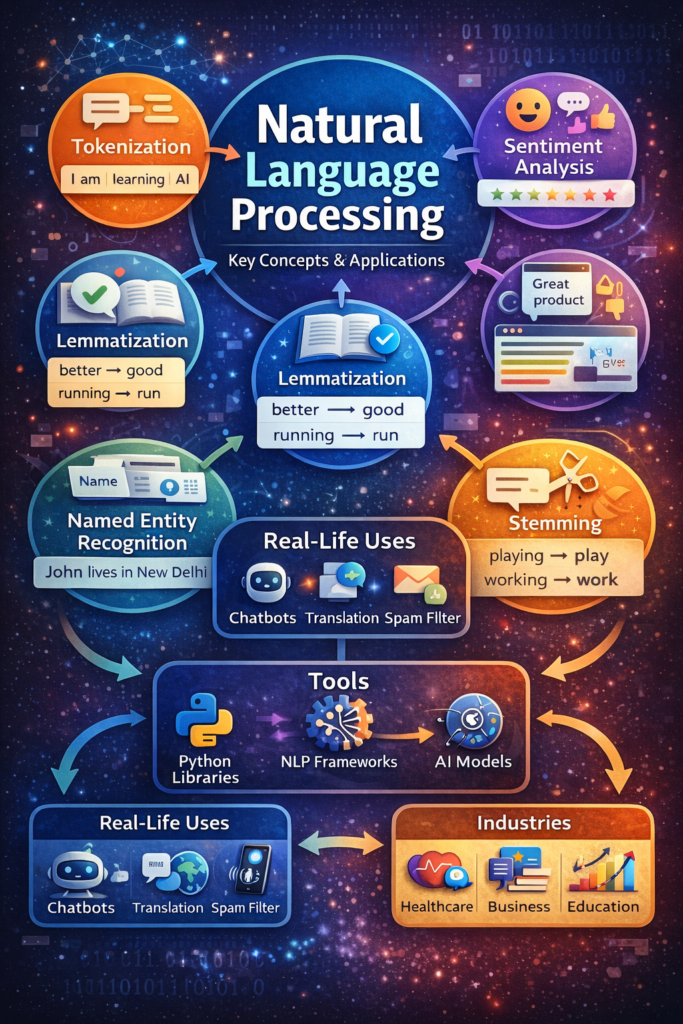
Natural Language Processing (NLP) is a technology that empowers computers to understand, analyze, and respond to human language. Simply put, natural language processing acts as a bridge that facilitates communication between human language and computer systems.
Natural Language Processing constitutes a significant branch within the field of artificial intelligence. While the overarching goal of artificial intelligence is to make machines intelligent, the specific objective of natural language processing is to teach machines to comprehend human language. This implies that a computer should not merely read words but also be capable of grasping their actual meaning.
For instance, consider a scenario where you search for a query on the internet—such as “best smartphone under 20,000.” The search engine does not merely match keywords; it also attempts to decipher your underlying intent. This function is accomplished with the aid of natural language processing.
The primary goal of natural language processing is to enable computers to process human language in a manner analogous to how a human would. This entails reading text, interpreting its meaning, and generating an appropriate response. Consequently, natural language processing finds application in chatbots, translation tools, voice assistants, and numerous other AI-driven applications.
In the contemporary landscape, natural language processing technology plays a pivotal role across various sectors, including business, education, healthcare, and online services. As AI technology continues to evolve, natural language processing is simultaneously becoming increasingly sophisticated.
- A Brief History of Natural Language Processing
While natural language processing has evolved into a highly advanced technology today, its development was not an overnight phenomenon. Its current state is the result of contributions from many years of dedicated research and experimentation.
The conceptualization of natural language processing dates back to approximately the 1950s. During that era, researchers were actively exploring the hypothesis of whether computers could effectively translate or comprehend human language. Early experiments were predominantly focused on language translation—specifically, the process of converting text from one language into another.
In its nascent stages, natural language processing systems relied primarily on rule-based frameworks. This meant that programmers manually defined grammar rules and language patterns. The computer would then process the text in accordance with these predefined rules. However, human language is highly complex; consequently, fully comprehending language solely through rules proved to be a difficult task.
Subsequently, technological advancements emerged, marking the beginning of the machine learning era. At this stage, natural language processing systems were fed vast amounts of text data, enabling computers to automatically learn patterns. This approach significantly enhanced language understanding.
In the present day, natural language processing has become even more powerful through its integration with modern AI models. Aided by advanced algorithms and deep learning techniques, machines can now interpret context, sentiment, and meaning with greater accuracy than ever before.
In short, the journey of natural language processing began with simple rule-based programs and has evolved to become a pivotal component of advanced AI technology today. Moving forward, natural language processing will continue to play a major role in the development of intelligent systems.
A Brief History of Natural Language Processing
Today, Natural Language Processing has become a powerful component of AI technology; however, its development has unfolded gradually over the course of many years. If we examine the history of natural language processing, it becomes evident that researchers have long sought to understand whether computers are capable of comprehending human language.
When Did the Concept of Natural Language Processing Begin?
The fundamental concept of natural language processing emerged around the 1950s. During that period, scientists and computer researchers were conducting experiments to determine whether computers could translate languages. Their primary objective was to enable a machine to convert text from one language into another—for instance, translating English into Russian or French.
At that time, computers lacked significant processing power, making work on natural language processing quite challenging. Nevertheless, researchers began to develop foundational concepts within this field.
The Era of Rule-Based Systems
Early-stage natural language processing relied predominantly on rule-based systems. Under this approach, programmers manually encoded linguistic rules—such as grammatical conventions, sentence structures, and word patterns.
The computer would analyze text by strictly adhering to these predefined rules. For example, if a sentence exhibited a specific pattern involving a noun and a verb, the system would process that sentence in accordance with the corresponding rule.
However, human language is inherently flexible and complex; the meaning of a single word can vary significantly depending on its context. Consequently, rule-based natural language processing systems were unable to consistently deliver flawless results.
The Machine Learning Era
As time progressed, technology advanced, and machine learning began to be applied to natural language processing. At this stage, rather than being manually fed specific rules, computers were provided with vast datasets of text.
By analyzing this data, the computer learned to identify linguistic patterns autonomously. This approach significantly enhanced the capabilities of natural language processing, as machines became adept at understanding language more effectively through exposure to real-world examples.
This era witnessed the development of various applications, including email spam detection, search engines, and text classification systems.
Modern AI Models
In the present day, natural language processing has evolved to become even more sophisticated, driven by the capabilities of modern AI models and deep learning technologies. Thanks to large language models and neural networks, machines can now understand context, sentiment, and meaning with greater accuracy than ever before.
It is precisely because of this technology that chatbots, voice assistants, and translation tools have become remarkably intelligent today. Modern natural language processing systems are even capable of handling human conversation in a highly natural manner.
In short, the journey of natural language processing began with simple rule-based systems and has now evolved into advanced AI models. In the future, natural language processing technology is set to become even more powerful, and its significance within the digital world is poised to grow even further.
How Does Natural Language Processing Work?
Many people believe that Natural Language Processing merely reads text; however, the actual process involved is somewhat deeper. Natural Language Processing follows a step-by-step system in which a computer first attempts to comprehend the text and subsequently generates a response based on that understanding.
Simply put, Natural Language Processing converts human language into a machine-friendly format so that a computer can grasp its meaning. Let’s understand this through a simple process.
The first step in Natural Language Processing is receiving input. This input can take the form of either text or voice.
Examples:
Google search query
Chat message
Voice command
If a user interacts via voice, the system first converts the voice input into text. Subsequently, Natural Language Processing processes that text.
Example sentence:
“Best laptop under 50000”
This sentence serves as the input for the Natural Language Processing system.
- Text Cleaning
After receiving the input, the Natural Language Processing system cleans the text. Real-world text often contains numerous extra characters, symbols, and unnecessary words that can hinder the comprehension of its meaning.
In this step, the system:
removes extra spaces
removes special symbols
converts the text into a simplified format
Example:
Original text
“Best laptop under 50000!!!”
Clean text
“best laptop under 50000”
This process makes it easier for the Natural Language Processing system to analyze the text.
- Tokenization
The next step is Tokenization. In this process, Natural Language Processing breaks down a sentence into smaller parts or individual words.
Example sentence:
“I love learning AI”
After Tokenization:
I | love | learning | AI
Now, the computer can analyze each word individually. This step is crucial for Natural Language Processing, as it is through this stage that the system begins to understand the structure of the language.
- Understanding Meaning
In this step, Natural Language Processing attempts to comprehend the actual meaning of the words. The computer analyzes:
the context of the sentence
what the user is searching for
the relationships between the words
Example:
A user searches for:
“best phone for photography”
Natural Language Processing understands that the user is seeking smartphone recommendations, rather than a photography course.
This step utilizes techniques such as sentiment analysis, entity recognition, and context understanding.
- Generating Output
In the final step, Natural Language Processing provides relevant output to the user. This output can take various forms:
search results
chatbot replies
translations
recommendations
Example:
If a user asks:
“What is AI?”
the Natural Language Processing system generates a meaningful answer.
It is through this very process that chatbots and AI assistants are able to provide responses that resemble human conversation.
Natural Language Processing Process Diagram
User Input (Text / Voice)
↓
Text Cleaning
↓
Tokenization
↓
Understanding Meaning
↓
Generating Output
Simple words mein agar samjhein to Natural Language Processing ek intelligent process hai jo human language ko analyze karta hai, uska meaning samajhta hai aur phir sahi response generate karta hai. Isi technology ki wajah se aaj search engines, chatbots aur voice assistants itne smart ban paaye hain.
Important Components of Natural Language Processing
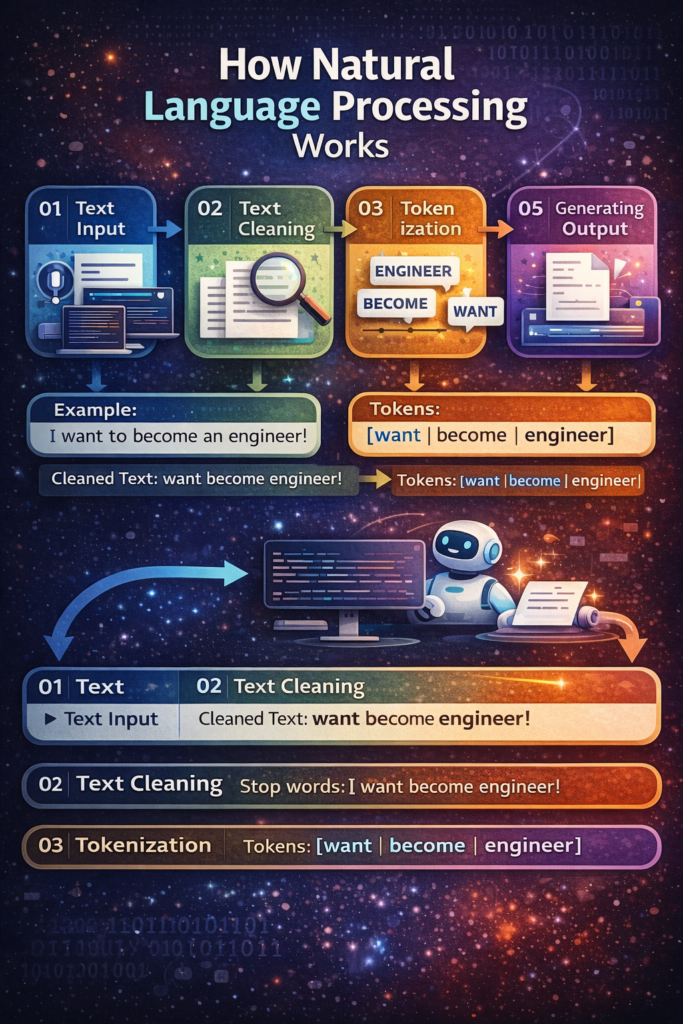
To understand Natural Language Processing, it is essential to grasp some of its key components. These components consist of techniques that assist a computer in analyzing human language and comprehending its meaning.
Simply put, Natural Language Processing is not a single-step process. It involves the utilization of numerous smaller steps and techniques that work in tandem to understand language.
Let’s explore some of the important components of Natural Language Processing, accompanied by simple examples.
- Tokenization
Tokenization is the most fundamental and crucial step in Natural Language Processing. In this process, a long sentence is broken down into smaller parts or individual words.
It is difficult for a computer to comprehend an entire sentence all at once; therefore, Natural Language Processing first breaks the sentence down into individual words.
Example sentence:
“I am learning Artificial Intelligence”
After Tokenization:
I | am | learning | Artificial | Intelligence
Now, the computer can analyze each word individually. This is precisely why Natural Language Processing systems are able to better understand the structure of a sentence.
- Lemmatization
Lemmatization is a technique in which words are converted into their base form—or dictionary form. This helps the computer in grasping the actual meaning of the words.
Example:
running → run
better → good
studies → study
Here, the Natural Language Processing system recognizes that all these words are related to their original forms. Thanks to this process, text analysis becomes more accurate.
- Stemming
Stemming is a concept similar to lemmatization, though it is a slightly simpler method. In this process, certain letters are removed from the end of a word to derive its root form.
Example:
playing → play
working → work
reading → read
Occasionally, stemming may not produce a perfectly formed word; nevertheless, it still assists the Natural Language Processing system in understanding the basic meaning of the words.
- Named Entity Recognition
Named Entity Recognition (NER) is an advanced component of Natural Language Processing. This technique is used to identify important names within a text.
This system can automatically detect:
A person’s name
A city or country
A company’s name
A date or time
Example sentence:
“Rohit Sharma lives in Mumbai and plays for India.”
A Natural Language Processing system can identify the entities in this sentence:
Rohit Sharma → Person
Mumbai → Location
India → Country
This technique is widely used in news analysis, search engines, and information extraction.
- Sentiment Analysis
Sentiment Analysis is a popular use case of Natural Language Processing. This technique is used to understand the emotion or opinion expressed within a text.
This means that the system identifies whether a sentence is:
Positive
Negative
Neutral
Example:
Sentence:
“This mobile phone is amazing and the camera quality is great.”
The Natural Language Processing system will detect this as having a positive sentiment.
Another example:
“This laptop is very slow and not worth the price.”
This sentence conveys a negative sentiment.
Companies use sentiment analysis to analyze customer reviews, allowing them to understand what people are thinking about their products.
Simply put, these components of Natural Language Processing analyze language step-by-step. With the help of these techniques, a computer breaks down words, understands their root forms, identifies important information, and can even detect the emotions embedded in a text. For this very reason, Natural Language Processing has become a powerful integral part of modern AI systems today.
Real-Life Examples of Natural Language Processing
If you look closely, Natural Language Processing is not limited merely to research or technology labs. In today’s world, Natural Language Processing has become an integral part of our daily digital lives. Whenever a system attempts to comprehend human language, Natural Language Processing is utilized in one form or another.
Let’s explore a few simple real-world examples to understand how Natural Language Processing is currently being applied.
- Chatbots
Nowadays, you can find chatbots on numerous websites. When you visit a company’s website and pose a question, an automated bot often responds to you.
These chatbots utilize Natural Language Processing to interpret the user’s message and formulate a response accordingly.
Example:
User message:
“Where is my order?”
With the aid of Natural Language Processing, the chatbot recognizes that the user is inquiring about the status of their order, and the system subsequently provides the relevant information.
Thanks to this technology, companies are able to provide 24/7 customer support.
- Google Translate
Language translation tools serve as a powerful example of Natural Language Processing. If you wish to convert text from one language into another, translation systems rely on Natural Language Processing to do so.
Example:
English sentence:
“I love learning technology.”
Hindi translation:
“मुझे तकनीक सीखना पसंद है।”
In this instance, the Natural Language Processing system does not merely translate individual words; rather, it comprehends the underlying meaning of the sentence to generate an accurate translation.
- Email Spam Detection
You may have noticed that certain messages in your email inbox are automatically routed to the Spam folder. This process, too, is facilitated by Natural Language Processing.
Email systems analyze the text to determine whether a message is:
an advertisement
a suspicious link
or an unwanted promotional item
If the system deems an email to be suspicious, Natural Language Processing categorizes it as spam.
This mechanism helps protect users from receiving unwanted emails.
- Voice Assistants
In recent times, voice assistants have become immensely popular across smartphones and various smart devices. When you issue a command to your phone using your voice, the system attempts to understand what you are saying.
Example commands:
“Play music”
“Set an alarm for 7 AM”
“What is the weather today?”
Here, Natural Language Processing converts the voice command into text, interprets its meaning, and then executes the appropriate action.
It is thanks to this very technology that voice assistants are able to provide an experience that closely resembles human conversation.
- Autocomplete in Search
When you type a query into a search engine, the system automatically displays suggestions for you. This feature is known as Autocomplete.
Example:
If you type:
“best laptop”
the search system might offer suggestions such as:
best laptop for students
best laptop under 50000
best laptop for gaming
These suggestions are generated with the aid of Natural Language Processing and data analysis. The system predicts what the user intends to search for.
Simply put, Natural Language Processing makes our digital lives easier and smarter. Features such as chatbots, translation tools, spam filters, voice assistants, and search suggestions have all become possible thanks to this technology. In the future, Natural Language Processing will become even more advanced, leading to the development of even more intelligent applications.
Practical Use Cases of Natural Language Processing
In today’s world, Natural Language Processing is no longer limited solely to technology companies. Many industries are utilizing Natural Language Processing to make their operations faster, smarter, and more efficient.
Thanks to its ability to comprehend human language, Natural Language Processing plays a pivotal role across various fields. Let’s explore this through examples from a few practical industries.
Healthcare
In the healthcare industry, Natural Language Processing is proving to be immensely helpful for doctors and hospitals. Hospitals generate a vast volume of medical records, reports, and doctor’s notes on a daily basis. Manually analyzing all this data is an incredibly time-consuming task.
This is where Natural Language Processing systems come in; they can automatically analyze text-based data and identify critical information. This capability assists doctors in understanding patient histories and medical details more effectively.
Medical Report Analysis
One significant use case for Natural Language Processing within the medical field is the analysis of medical reports. Hospitals deal with a massive volume of lab reports, prescriptions, and diagnostic notes.
Natural Language Processing can scan these reports to identify key keywords and specific medical conditions. For instance, the system can automatically detect which specific disease is mentioned in a report or determine the type of treatment a patient requires.
With the aid of this technology, doctors gain rapid insights, and the overall decision-making process is significantly enhanced.
Business
The adoption of Natural Language Processing is also growing rapidly within the business world. Companies are deploying NLP-based tools to facilitate better communication and provide superior support to their customers.
A prime example of this is customer support chatbots. Many companies utilize automated chatbots on their websites and mobile applications to provide instant responses to customer inquiries.
Natural Language Processing enables these chatbots to decipher the meaning behind a user’s message, thereby allowing them to generate responses that mimic natural human conversation.
Education
The application of Natural Language Processing is gradually expanding within the education sector as well. Online learning platforms and digital educational tools are leveraging NLP technology to deliver enhanced learning experiences to students.
One such example is automated essay evaluation. Through this system, Natural Language Processing analyzes students’ written responses and evaluates them based on grammar, structural coherence, and semantic meaning. This saves teachers’ time and enables students to receive feedback quickly.
Marketing
In the field of marketing, Natural Language Processing is used to understand customer behavior and opinions. Today, companies analyze social media content, product reviews, and feedback comments.
Here, Natural Language Processing is utilized for customer sentiment analysis. The system automatically detects whether customers hold a positive, negative, or neutral opinion regarding a specific product or brand.
Example:
Customer review:
“This product quality is amazing and worth the price.”
The Natural Language Processing system will identify this review as expressing positive sentiment.
This type of analysis helps companies improve their products and services.
Simply put, Natural Language Processing is making work smarter and faster across various industries. The use of Natural Language Processing is continuously expanding in sectors such as healthcare, business, education, and marketing, and the importance of this technology is set to grow even further in the future.
Popular Natural Language Processing Tools
If a beginner wishes to learn Natural Language Processing, there are several tools and libraries available that make the process of handling language data much easier. With the aid of these tools, developers and researchers can analyze text, decipher language patterns, and build intelligent applications.
The good news is that many of the tools available for Natural Language Processing are free and open-source. This means that beginners, too, can easily get started with practicing and learning.
Let’s explore some popular Natural Language Processing tools, explained in simple terms.
Python Libraries for Natural Language Processing
In the programming world, Python is considered the most popular language for Natural Language Processing. Python offers numerous powerful libraries that simplify the task of processing text data.
For instance, NLTK is a widely used library that helps beginners grasp fundamental Natural Language Processing concepts, such as tokenization, text analysis, and language processing.
Another popular library is spaCy. This library is designed for fast and efficient NLP processing. Developers utilize it to analyze large volumes of text data and identify specific language patterns.
Using Python libraries is particularly beneficial for beginners, as they provide ready-made functions that streamline and simplify various Natural Language Processing tasks.
NLP Frameworks
Natural Language Processing frameworks assist developers in building advanced applications. Essentially, frameworks are collections of tools designed to help organize machine learning and language processing tasks.
For example, TensorFlow is a powerful framework used to create AI and Natural Language Processing models. With the help of this framework, developers can train machine learning models on large datasets.
Another popular framework is PyTorch. This framework is extensively used in research and deep learning projects, and it is also widely popular for developing Natural Language Processing models.
AI Models for Natural Language Processing
In modern AI systems, Natural Language Processing is implemented through powerful AI models. These models are trained on vast amounts of text data, enabling them to automatically learn and recognize language patterns.
For instance, BERT is a popular AI model utilized to understand the context and meaning of text. Models of this type enhance the capabilities of search engines and question-answering systems.
Nowadays, Large Language Models are also making Natural Language Processing even more advanced. These models can understand and generate human conversation in a remarkably natural manner.
Where Should Beginners Start?
If a beginner wishes to learn Natural Language Processing, it is most helpful to first grasp basic programming and text processing concepts.
A beginner’s roadmap could be quite simple:
Learning the basics of Python programming
Understanding how to process text data
Experimenting with basic NLP libraries such as NLTK or spaCy
Building simple projects (such as sentiment analysis)
Through step-by-step practice, any learner can gradually master the concepts of Natural Language Processing.
Simply put, Natural Language Processing tools assist developers and learners in analyzing human language and building intelligent systems. Thanks to Python libraries, NLP frameworks, and modern AI models, learning Natural Language Processing has become significantly more accessible today than ever before.
Challenges in Natural Language Processing
Today, Natural Language Processing technology has become quite advanced; however, fully comprehending human language remains a difficult task for machines. Human language is inherently flexible and complex. A single word can convey different meanings depending on the specific context or situation.
For this very reason, researchers and developers face numerous challenges when developing Natural Language Processing systems. Let us explore these significant challenges with the help of simple examples.
Language Ambiguity
Language ambiguity is one of the most common challenges in Natural Language Processing. Ambiguity implies that the meaning of a sentence or word is unclear and can be interpreted in multiple ways.
Example sentence:
“I saw a man with a telescope.”
This sentence can be interpreted in two ways:
I used a telescope to observe a man.
I observed a man who was in possession of a telescope.
The human brain can easily deduce the correct meaning based on the surrounding context. However, resolving this type of ambiguity can be a challenging task for a Natural Language Processing system.
Multiple Meanings of Words
In human language, many words possess multiple meanings. Consequently, identifying the correct intended meaning becomes difficult for Natural Language Processing systems.
Example word:
“Bank”
Its meaning could refer to:
A financial institution (where money is deposited).
A riverbank (the edge of a river).
If the sentence reads:
“I sat near the bank.”
The Natural Language Processing system must analyze the context to determine which specific meaning is applicable in this instance.
Context Understanding
Context plays a crucial role in human conversation. Sometimes, the true meaning of words becomes clear only when the entire situation or background is fully understood.
Example:
A friend says:
“That movie was sick.”
In its literal sense, “sick” refers to an illness; however, in casual conversation, it can also be used to mean “very good” or “excellent.”
Understanding this type of informal language and slang can be a challenging task for Natural Language Processing systems.
Data Bias
Data bias also constitutes a significant challenge within the field of Natural Language Processing. NLP systems are typically trained on large datasets. If the training data contains bias, the system may also generate biased results.
For instance, if a dataset contains limited information regarding a specific topic or group, the Natural Language Processing system’s understanding may be incomplete.
Therefore, researchers and developers must carefully select training data to ensure that the system produces fair and balanced results.
Simply put, Natural Language Processing attempts to understand human language; however, due to the inherent complexity of language, certain challenges naturally arise. Addressing issues such as linguistic ambiguity, multiple meanings, contextual understanding, and data bias constitutes a crucial part of NLP research. In the future, as technology continues to advance, Natural Language Processing systems will be able to handle these challenges even more effectively.
The Future of Natural Language Processing
The world of technology is changing at a rapid pace, and Natural Language Processing (NLP) constitutes a vital part of this evolution. The systems that currently possess a basic understanding of human language are poised to become even more intelligent and accurate in the future.
Experts believe that in the coming years, the application of Natural Language Processing will expand across an even wider range of industries and digital services. Let us explore some of the key future trends in simple, easy-to-understand language.
Enhancements in AI Chatbots
In today’s landscape, numerous websites and applications utilize AI chatbots. These chatbots are capable of answering basic queries and providing customer support.
In the future, powered by Natural Language Processing, chatbots will evolve to become significantly smarter. They will not merely answer simple questions but will also be able to effortlessly comprehend and engage in extended conversations.
This implies that future chatbots will be capable of conducting natural, human-like conversations, much like human customer support agents.
Improved Language Comprehension
Even today, AI systems often struggle to fully grasp human language—particularly when the language is complex or informal. However, thanks to ongoing research and advanced AI models, Natural Language Processing systems in the future will be able to understand language with far greater proficiency.
Future systems will be capable of analyzing context, emotions, and the semantic meaning of sentences with greater precision. This will result in smoother and more seamless communication between humans and machines.
The Growth of Voice AI
The adoption of voice technology has already become quite widespread. Smartphones, smart speakers, and various other devices now readily support voice commands.
In the future, Natural Language Processing will further amplify the capabilities of voice-based technology. Voice assistants will be able to interpret user input not merely at the level of individual words, but also within the broader context of the conversation.
Consequently, people are likely to rely more heavily on voice commands rather than typing to interact with their devices.
The Evolution of AI Assistants
In the future, AI assistants are set to become even more sophisticated. These assistants will be capable of handling not just simple tasks, but complex assignments as well.
For instance, future Natural Language Processing systems will be able to:
Summarize emails
Generate summaries of meetings
Rapidly retrieve research-related information
Such intelligent assistants have the potential to significantly boost productivity. Simply put, the future of Natural Language Processing is quite promising. Thanks to innovations such as AI chatbots, voice technology, and intelligent assistants, human-machine interaction will become even more natural and efficient. In the times to come, Natural Language Processing is set to become an even more integral part of digital technology.
How to Start Learning Natural Language Processing
If you wish to learn Natural Language Processing, the good news is that even beginners can easily get started with it, step by step. Today, numerous resources are available on the internet, enabling any student or beginner to grasp the fundamental concepts of Natural Language Processing.
The most important point to note is that Natural Language Processing is a combination of programming, language understanding, and machine learning. Therefore, following a simple roadmap proves helpful when learning this field.
Let’s break down the Natural Language Processing learning roadmap for beginners into simple steps.
Step 1: Learn Python Basics
The very first step toward learning Natural Language Processing is to understand the Python programming language. Python is widely regarded as the most popular language for NLP and AI development.
Python is a beginner-friendly language with a simple syntax. Once you grasp the basics of Python—such as variables, loops, functions, and lists—you can easily proceed to learn the subsequent concepts of Natural Language Processing.
Example topics that beginners should learn include:
Variables
Loops
Functions
Lists and Dictionaries
These fundamental concepts prove immensely helpful when building NLP projects in the future.
Step 2: Understand Text Processing
Following the Python basics, the next step is to understand text processing, as the primary function of Natural Language Processing is to analyze text data.
In the realm of text processing, you will learn concepts such as:
Text cleaning
Word tokenization
Stop word removal
Basic text analysis
For instance, consider the following sentence:
“I love learning artificial intelligence”
A Natural Language Processing system would break this sentence down into individual words and then proceed to analyze them.
At this stage, you can practice your skills by building simple text analysis programs.
Step 3: Machine Learning Basics
Machine learning is utilized to make Natural Language Processing even more powerful. Machine learning endows a computer with the ability to learn patterns from data.
Beginners should familiarize themselves with the fundamental concepts of machine learning, such as:
Training data
Prediction models
Classification
Pattern recognition
For example, machine learning is applied in sentiment analysis, where a system identifies whether a given piece of text conveys a positive or negative sentiment. Understanding machine learning concepts makes the development of Natural Language Processing applications much easier.
Step 4: Using NLP Libraries
Once you have grasped the basics of Python and machine learning, the next step is to utilize Natural Language Processing libraries.
Libraries provide developers with ready-made tools that allow language processing tasks to be performed with ease.
Popular libraries such as NLTK and spaCy are particularly useful for beginners. With the help of these libraries, you can perform tasks such as tokenization, sentiment analysis, and named entity recognition.
Practicing by building small projects is the best way to learn Natural Language Processing.
Simply put, to learn Natural Language Processing, you should first understand the basics of Python, then learn text processing and machine learning concepts, and finally, practice using NLP libraries. By following this step-by-step learning approach, any beginner can build a strong foundation in Natural Language Processing.
Conclusion
Simply put, Natural Language Processing (NLP) is a technology that enables communication between human language and computer systems. In today’s world, NLP is no longer merely a research topic; it has become an integral part of our daily digital lives.
Whenever we type a query into a search engine, interact with a voice assistant, or utilize translation tools, NLP is at work behind the scenes. Thanks to this technology, machines are becoming capable of understanding human language and generating meaningful responses.
In the future, NLP is poised to become even more powerful. With the growth of AI chatbots, voice assistants, and intelligent AI tools, the role of NLP will become increasingly significant. As artificial intelligence continues to evolve, NLP will simultaneously become more advanced.
If you have an interest in technology, AI, and future innovations, understanding and learning about NLP could prove to be a valuable skill for you.
If you would like to learn more about technologies such as AI, Machine Learning, and Natural Language Processing, please follow our blog.