
Introduction: AI Image Generator Kya Hai?
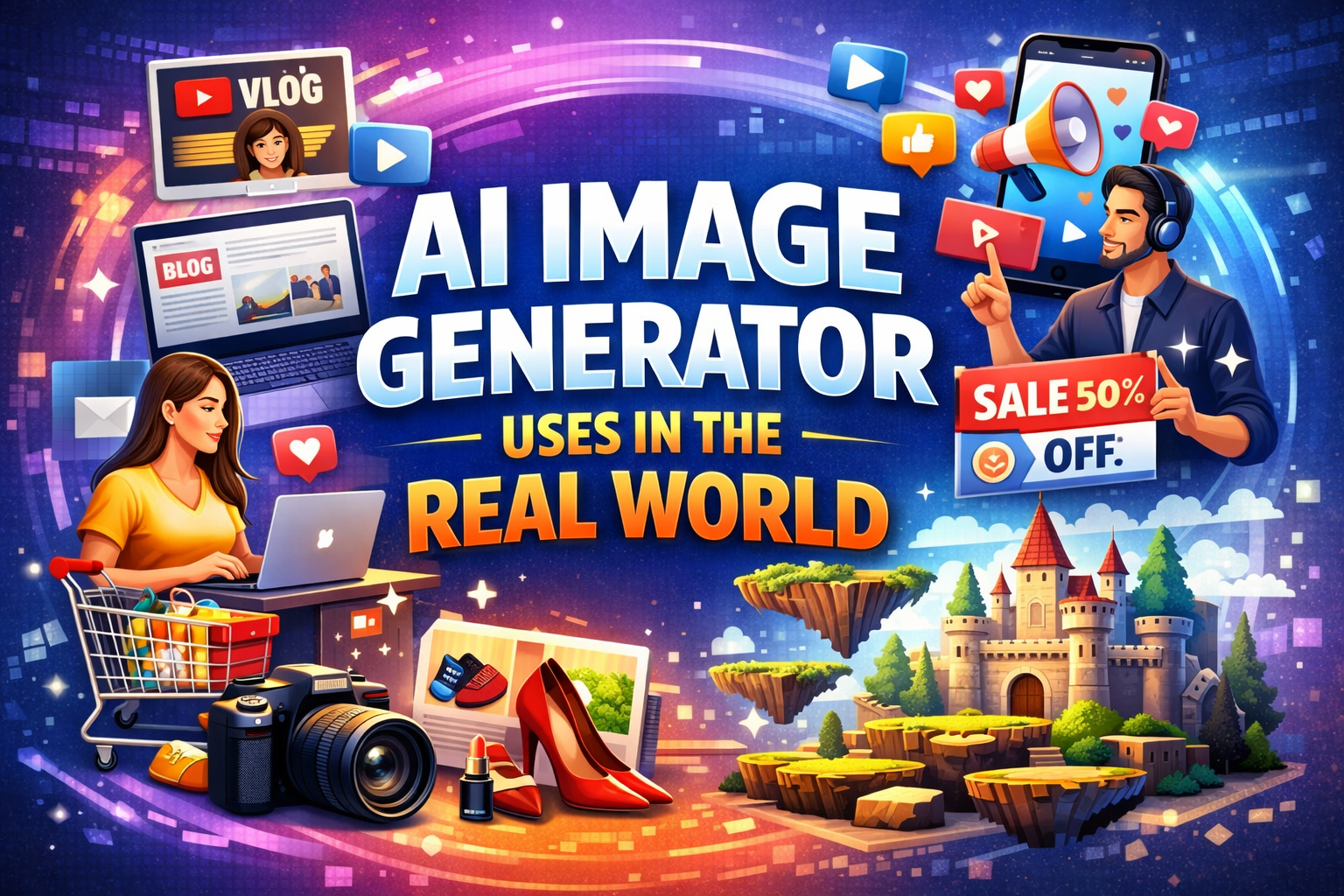
In today’s digital world, the role of images has become incredibly important. Whether you are writing a blog, creating social media posts, designing YouTube thumbnails, or engaging in online marketing—attractive images are a necessity everywhere. However, the challenge is that not everyone possesses graphic design skills, and hiring a professional designer isn’t always feasible. This is precisely where an AI image generator emerges as a powerful solution.
An AI image generator is a smart tool that utilizes artificial intelligence to create images based solely on text descriptions. Simply put, if you provide the AI with a written description of the type of image you desire, it interprets that description and automatically generates a brand-new image. This process is often referred to as “text-to-image generation.”
For instance, if you enter a prompt such as the following:
“A futuristic city at sunset, neon lights, cyberpunk style”
The AI image generator will create a unique image corresponding to that description within just a few seconds. The most fascinating aspect is that these images are entirely original—meaning the AI generates them from scratch.
Underlying this technology are powerful AI models that learn by analyzing millions of images and patterns. When a user enters a prompt, the AI interprets it and, drawing upon its training data, creates a new image.
In the current landscape, the significance of AI image generators is growing rapidly. Bloggers, marketers, designers, content creators, and businesses alike are leveraging this tool because it:
can generate high-quality images in a matter of seconds
assists in visualizing creative ideas
makes it possible to create professional-grade images even without formal design skills
Therefore, if you create online content or work within the digital realm, an AI image generator is a tool that can elevate both your creativity and your productivity to the next level.
2. How Does an AI Image Generator Work?
Many people believe that an AI Image Generator is merely a magical tool that automatically conjures up images. However, in reality, its operation relies on highly advanced artificial intelligence technology. The good news is that, from a user’s perspective, the actual process is quite simple.
Once you grasp the basic workflow, you will easily understand how an AI Image Generator converts text into an image.
Let’s break this down step-by-step using simple language.
- The User Writes a Prompt
The very first step is writing a prompt. A prompt is the description you provide to the AI so that it can understand exactly what type of image you are looking for.
Example prompts:
“Sunset view over a mountain, realistic photography style”
“Cute cartoon dog playing in the park”
The clearer and more detailed your prompt is, the better the image the AI Image Generator will create.
- The AI Model Analyzes the Prompt
When you submit a prompt, the AI model within the AI Image Generator analyzes that text.
The AI attempts to understand every single word in the prompt, identifying elements such as:
What is the object? (dog, city, mountain)
What is the environment? (park, beach, space)
What is the style? (cartoon, realistic, digital art)
During this process, the AI translates the language into a visual concept.
- Patterns Are Identified from the Dataset
During their training phase, AI models are exposed to millions of images and patterns. This is why the AI Image Generator knows what the shapes, colors, and styles of various objects typically look like.
When the AI analyzes a prompt, it identifies relevant patterns within its own training data.
For example:
“Sunset” implies an orange and red sky
“City” implies buildings and roads
“Cartoon style” implies simplified shapes
By combining these patterns, the AI constructs a visual concept.
- The AI Generates a New Image
In the final step, the AI Image Generator creates a completely new image.
This image is not a copy of any existing photograph. AI actually generates pixels step-by-step to construct a unique image.
Within just a few seconds, AI can even provide you with multiple image options, from which you can select the best one.
Simple Diagram (AI Image Generation Flow)
To understand this as a simple workflow, the process of an AI image generator looks something like this:
Prompt → AI Model Analysis → Image Creation Process → Final AI-Generated Image
In short, an AI image generator interprets text and converts it into a visual form. For this very reason, this technology has emerged as a powerful creative tool for bloggers, designers, and content creators in today’s landscape.
3. The History of AI Image Generators
The modern AI Image Generator tools we use today were not developed overnight. They are the result of years of research, experimentation, and advancements in the field of artificial intelligence. If we trace its history, AI image generation technology has evolved gradually—from simple experiments to the highly realistic images we see today.
Let’s understand, in simple terms, how the development of AI Image Generators unfolded.
- The Dawn of AI Image Generation
The concept of generating images using AI first emerged in research laboratories around 2010. At that time, researchers were conducting experiments to determine whether a computer could not only comprehend images but also create them.
Early AI models were quite rudimentary; they were capable of generating only basic shapes or blurry images. The quality of these images was relatively poor, and it was often difficult to clearly identify their content.
Nevertheless, these experiments laid the foundation for the powerful AI Image Generator tools of the future.
- Early AI Image Tools
As AI technology began to mature, early tools and research models emerged that possessed the capability to generate images. These tools were primarily utilized for research purposes and were not readily accessible to the general public.
The primary objective of these tools was to train AI to recognize and understand patterns within images—such as the shape, color, and structure of various objects.
At this stage, AI image generation technology was still in its nascent, “learning” phase.
- Deep Learning Changes the Game
The most significant breakthrough in AI image generation occurred with the rise in popularity of Deep Learning technology. Deep learning is an advanced machine learning technique that utilizes neural networks to train a computer to identify and learn patterns from data.
Leveraging the power of deep learning, AI Image Generator models were exposed to datasets comprising millions of images. Through this rigorous training, the AI gradually developed an understanding of how various objects appear visually.
Consequently, the AI became capable of generating images that were significantly clearer and of higher quality than ever before. 4. Introduction to GAN Models
A pivotal step in the history of AI image generation was the introduction of GAN models (Generative Adversarial Networks).
In GAN models, two AI systems work in tandem:
One model creates an image.
The second model evaluates whether the image appears real or fake.
Due to this competitive dynamic, AI Image Generators gradually began producing increasingly realistic images. This technology marked a major milestone in the fields of AI art and image generation.
- Diffusion Models and Modern AI Image Generators
The advanced AI Image Generator tools available today frequently utilize Diffusion Models.
The concept behind Diffusion Models is simple:
The AI initially treats the image as if it were random noise.
It then removes this noise step-by-step.
Finally, a clear and detailed image is produced.
It is thanks to this technology that modern AI tools are capable of generating extremely realistic and creative images.
Summary
To summarize this history briefly, the evolution of AI Image Generator technology unfolded as follows:
Basic Experiments → Deep Learning → GAN Models → Diffusion Models
Today, AI image generation technology has become so powerful that professional-quality images can be created using nothing more than a text prompt. Furthermore, this technology is poised to become even more advanced in the future.
4. Popular AI Image Generator Tools
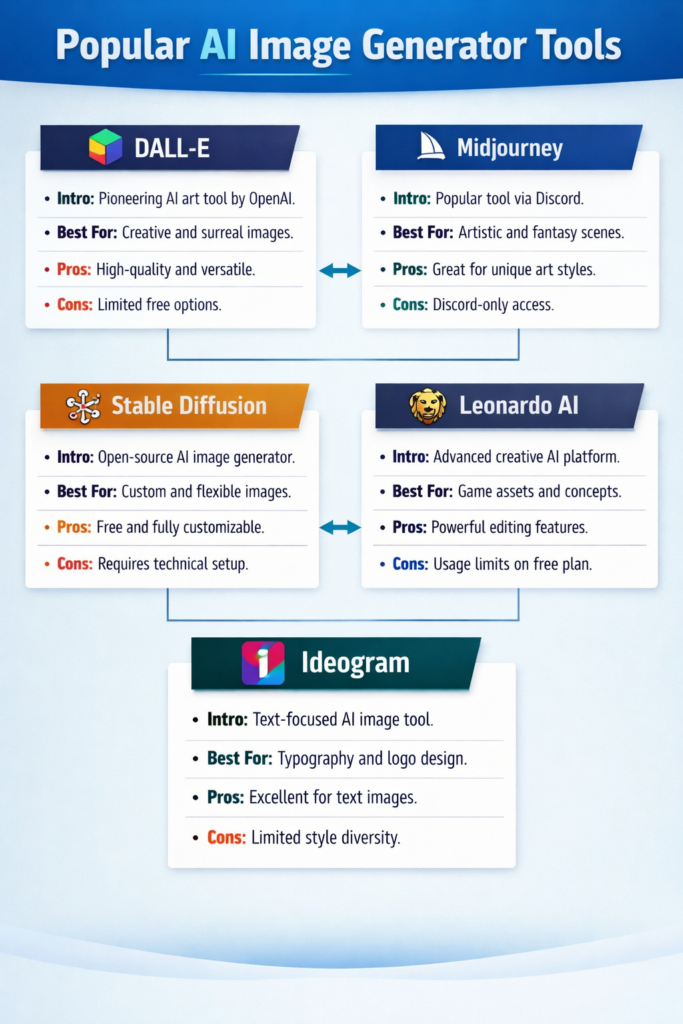
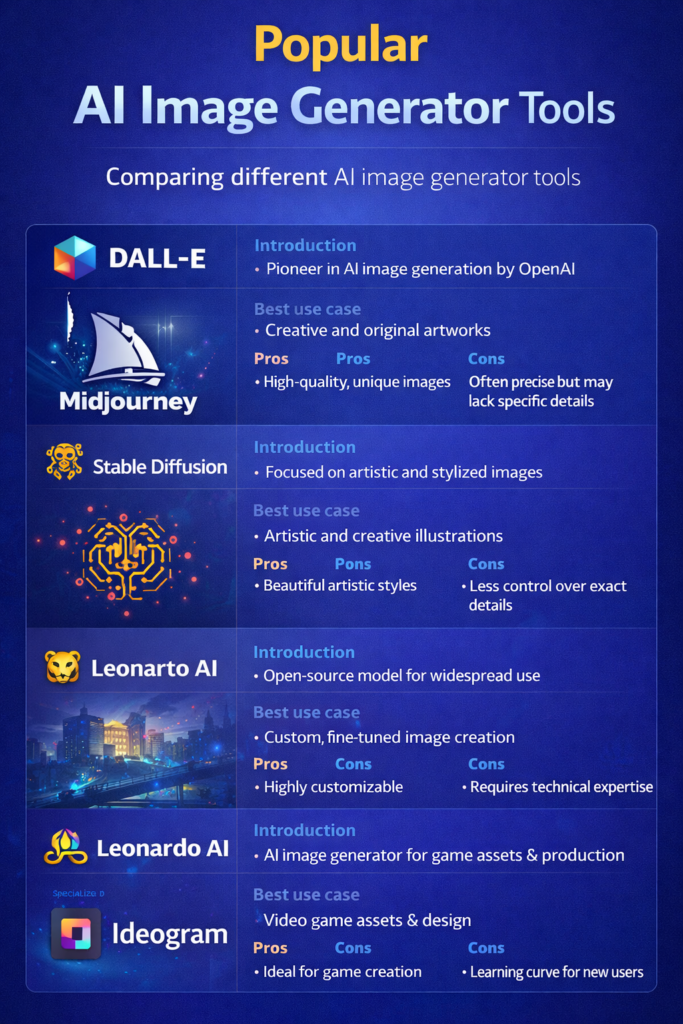
In today’s landscape, numerous AI image generator tools are available on the market that can create high-quality images solely from text prompts. Each tool possesses its own unique strengths. Some tools are user-friendly for beginners, while others offer powerful features tailored for professional designers and creators.
If you are looking to start utilizing AI image generation technology, the popular tools listed below could prove to be highly useful for you.
- DALL‑E
DALL-E is a powerful AI image generator tool capable of transforming text descriptions into realistic and creative images. This tool was developed to enable users to create unique images simply by writing a basic prompt.
Best Use Cases
Blog images
Creative illustrations
Marketing graphics
Pros
Easy-to-use interface
Generates high-quality images
Interprets detailed prompts effectively
Cons
Free generation capabilities may be limited
Certain advanced features are available only in the paid version
- Midjourney
Midjourney is a highly popular AI image generator, specifically renowned for its ability to create artistic and visually stunning images. This tool enjoys significant popularity among creative artists and designers.
Best Use Cases
Digital art
Concept art
Creative design projects
Pros
Extremely artistic image style
Unique visual quality
Impressive results for creative prompts
Cons
Can be somewhat confusing for beginners
Typically requires a subscription
- Stable Diffusion
Stable Diffusion is an open-source AI image generation model that offers greater flexibility to developers and creators. This tool can even be run locally on a personal computer, provided the system hardware is sufficiently powerful.
Best Use Cases
Developers and advanced users
Custom AI image models
Experimentation and research
Pros
Open-source technology
Highly customizable
Options for free usage are available
Cons
Setup can be challenging for beginners
May require powerful hardware
- Leonardo AI
Leonardo AI is a modern AI image generation platform considered particularly useful for designers and game creators. This tool assists in generating high-quality assets and creative visuals. Best Use Cases
Game design assets
Creative artwork
Social media visuals
Pros
User-friendly interface
Multiple design styles available
Fast image generation
Cons
Free credits are limited
A paid plan may be required for heavy usage
- Ideogram
Ideogram is a unique AI image generator tool that is particularly renowned for its ability to generate text within images. If you need to create logo designs, posters, or typography-based images, this tool can be extremely useful.
Best Use Cases
Logo ideas
Posters
Typography images
Pros
Generates accurate text within images
Useful for creative poster design
Simple interface
Cons
Some image styles may be limited
Offers limited advanced customization options
Final Thoughts
If you are a beginner, it would be easiest to start with AI image generator tools like DALL-E or Leonardo AI. If your goal is to create creative art, Midjourney might be the best option. And if you are looking for experimentation and customization, Stable Diffusion is a powerful choice.
With the help of these tools, anyone today can create professional-quality images simply by writing a basic text prompt.
5. A Step-by-Step Guide to Using an AI Image Generator
If you are using an AI Image Generator for the first time, you might feel that this technology is somewhat complicated. However, the actual process is quite simple. Even beginners can create their first AI image in just a few minutes.
Below is a simple step-by-step guide that allows anyone to easily start using an AI Image Generator.
Step 1: Choose an AI Tool
The very first step is to select a good AI Image Generator tool. There are many tools available on the internet, but for beginners, it is best to choose a tool that is simple and user-friendly.
You can select a tool based on your specific needs. For example:
for creative images
for blog images
for social media graphics
A good AI Image Generator tool provides you with fast and high-quality results.
Step 2: Create an Account
Once you have chosen a tool, the next step is to create an account.
Signing up on most AI Image Generator platforms is very easy. Typically, you can:
sign up using your email address
log in using your Google account
After creating an account, you gain access to the tool’s dashboard, which is where the image generation process begins.
Step 3: Write a Prompt
Now comes the most important step—writing a prompt.
A “prompt” refers to the description you provide to the AI Image Generator so that it understands exactly what type of image you require.
Example prompts:
“Beautiful mountain landscape at sunrise, realistic photography style”
“Cute cartoon cat playing with a ball”
The clearer and more detailed your prompt is, the better the image the AI will generate.
Step 4: Generate the Image
After writing the prompt, you simply need to click on the “Generate” button.
The AI Image Generator then analyzes your prompt and creates one or multiple images within a few seconds.
Often, these tools will also display different variations of the image, allowing you to choose the best one that suits your preferences. Step 5: Download the Image
Once you are satisfied with the generated image, the final step is to download it.
Most AI Image Generator platforms offer you the option to:
download the image in high resolution
share the image directly to social media
After downloading, you can use the image in blogs, social media posts, presentations, or marketing content.
Quick Summary
To put it simply, the process of using an AI Image Generator looks something like this:
Choose AI Tool → Create Account → Write Prompt → Generate Image → Download Image
Nowadays, AI Image Generator tools have become so user-friendly that even a complete beginner—without any design skills—can create professional-looking images. For this very reason, this technology has become incredibly useful for bloggers, marketers, and content creators.
6. Best Prompt Writing Tips (Important Section)
When you use an AI Image Generator, one element is of paramount importance—the prompt. A prompt is the text description you provide to the AI so that it can understand exactly what type of image you desire.
Simply put, the quality of the images produced by an AI Image Generator depends 70–80% on the prompt itself. If the prompt is clear and detailed, the AI will generate a superior and more realistic image.
Therefore, it is crucial for beginners to understand the fundamentals of prompt writing. Below, you will find several practical tips designed to help you create high-quality images using an AI Image Generator.
- Write a Clear Description
The first rule is that your prompt must be both clear and specific. If the description is vague, the AI Image Generator may become confused, potentially resulting in a mediocre outcome.
Example:
Weak Prompt
“City image”
Better Prompt
“Modern city skyline at sunset with tall glass buildings”
Here, the second prompt is significantly clearer, making it much easier for the AI to interpret.
- Specify an Image Style
If you want the AI Image Generator to create an image in a specific artistic style, it is helpful to explicitly mention that style within your prompt.
Example styles:
realistic photography
cartoon style
digital art
watercolor painting
3D render
Example prompt:
“Cute panda sitting on a tree branch, cartoon style, colorful illustration”
Adding a specific style can completely transform the overall look and feel of the image.
- Mention Lighting
Lighting plays a pivotal role in professional-quality images. Similarly, an AI Image Generator produces superior visuals when provided with specific lighting details.
You can incorporate lighting-related terms into your prompt, such as:
sunset lighting
soft light
cinematic lighting
golden hour light
dramatic lighting
Example prompt:
“Mountain landscape with golden sunset lighting, ultra realistic”
Adding lighting details makes the image appear more attractive and cinematic.
- Specify the Camera Angle
If your goal is to generate images that mimic a photographic style, specifying the camera angle can be extremely helpful. This is a technique that professional creators frequently employ when generating images using AI tools. Example camera angles:
Close-up shot
Wide-angle view
Aerial view
Top view
Portrait shot
Example prompt:
“Luxury sports car on a highway, low-angle shot, cinematic lighting”
Prompts of this type make the resulting image look more professional.
Example Prompt
If you want to write a powerful prompt, you can combine multiple elements within it.
Example:
“Futuristic city at sunset, cyberpunk style, neon lights, ultra-realistic, 4K”
In this prompt:
Subject → Futuristic city
Lighting → Sunset
Style → Cyberpunk
Quality → Ultra-realistic, 4K
Similarly, structured prompts provide better guidance to an AI Image Generator.
Final Tip
If you want to create amazing images using an AI Image Generator, treat prompt writing as a creative skill. Experiment with different styles, lighting, and descriptions. The more you experiment, the better your results will be.
Over time, you will come to understand how to transform a simple prompt into a powerful one.
7. Real-World Uses of AI Image Generators
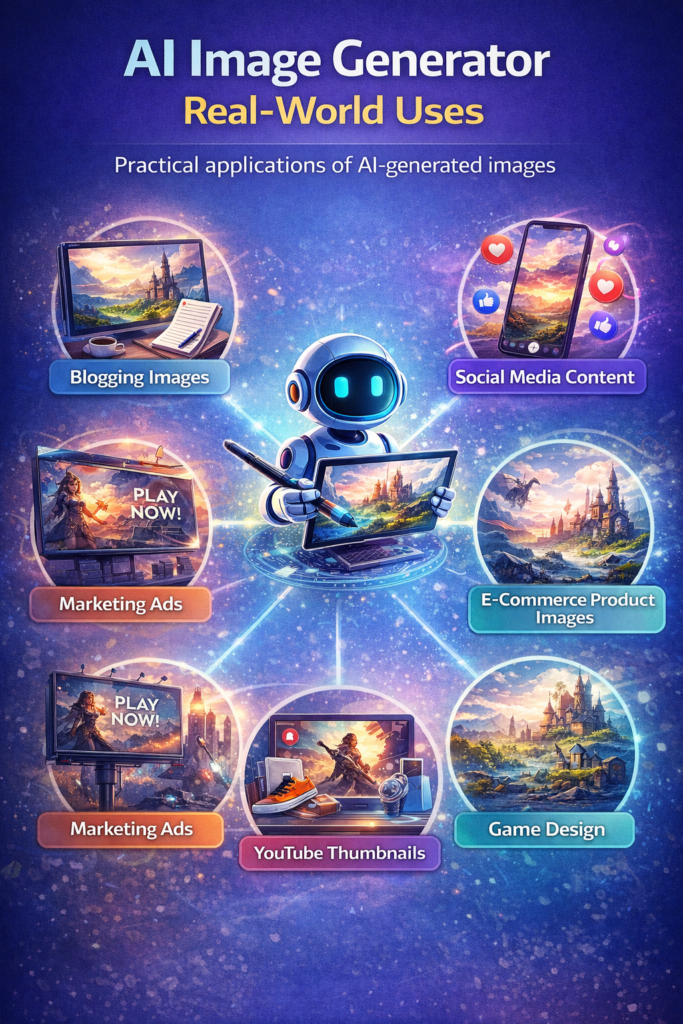
In today’s digital age, AI Image Generators are no longer merely creative tools; they are also being widely utilized for practical applications. Bloggers, marketers, YouTubers, designers, and businesses alike are all incorporating AI Image Generators into their daily workflows.
The best part is that being a graphic design expert is no longer a prerequisite for creating professional-looking images. High-quality visuals can now be generated simply by writing a concise text prompt.
Let’s explore some real-world applications through simple examples.
- Blogging Images
Images play a crucial role in blogging. When a blog post features high-quality visuals, it significantly boosts reader engagement and interest.
Today, many bloggers are utilizing AI Image Generators to create visuals for their articles. With the help of these tools, they can:
create featured images
generate diagrams and illustrations for their blogs
incorporate unique visuals
This gives the blog a professional aesthetic and makes the content far more engaging.
- Social Media Content
On social media platforms such as Instagram, Facebook, and LinkedIn, visually appealing images are paramount. Here, AI Image Generators have emerged as a powerful tool for content creators.
With the assistance of AI, creators can:
design creative posts
generate images featuring motivational quotes
create unique digital artwork
This ensures that their social media content remains fresh and eye-catching.
- Marketing Ads
In the realm of digital marketing, visuals exert a powerful influence. Businesses are leveraging AI Image Generators to make their advertisements more compelling and attractive.
With the aid of AI tools, marketers can:
create ad banners
design promotional images for products
generate creative assets for social media advertising
This makes their marketing campaigns significantly more engaging and effective.
- E-commerce Product Images
For online stores and e-commerce businesses, product images are of critical importance. Conducting a professional photoshoot for every single product can, at times, prove to be a costly endeavor.
In such situations, an AI Image Generator can prove to be an invaluable asset. With its help, sellers can:
create product mockups
design creative product backgrounds
generate promotional product images
This makes e-commerce listings appear even more attractive.
- YouTube Thumbnails
Clicks on YouTube videos largely depend on the thumbnail. If a thumbnail is attractive, the chances of viewers clicking on the video increase significantly.
For this reason, many YouTubers use AI Image Generators to design their thumbnails. With the help of AI:
creative thumbnail backgrounds can be created
unique character images can be generated
eye-catching visuals can be produced
This also enhances the overall aesthetic of the channel.
- Game Design
The use of AI Image Generators is also growing rapidly within the game development industry. Game designers can utilize AI tools to quickly generate creative assets.
Examples:
game characters
fantasy environments
concept art
background designs
This makes the game development process both faster and more creative.
Final Thoughts
Today, AI Image Generator technology is no longer merely a tool for experimentation; it is being actively utilized in real-world projects. In fields such as blogging, marketing, social media, e-commerce, and game design, its application provides creators with fast and creative solutions.
For this very reason, AI Image Generator tools are poised to become an integral part of digital content creation in the future.
8. Advantages of AI Image Generators
In today’s digital world, AI Image Generator technology is gaining popularity at a rapid pace. The primary reason for this is that it makes the creative process faster, easier, and more innovative for both creators and businesses alike. While creating a professional image previously required graphic design software and specialized skills, AI Image Generators now enable anyone to create an image simply by writing a text prompt.
Let’s explore some of the key advantages of AI Image Generators in simple terms.
- Fast Image Creation
The biggest advantage is that AI Image Generators operate with great speed. In the past, designing an image was a time-consuming process; a graphic designer had to conceptualize the idea and then use design tools to bring the image to life.
However, with an AI Image Generator, you simply write a prompt, and the image is generated within a matter of seconds. This speed proves incredibly beneficial for bloggers, marketers, and content creators.
- No Design Skills Required
Not everyone possesses graphic design skills. Learning to use tools like Photoshop or other design software takes time. However, with an AI Image Generator, you do not need any specialized design expertise.
If you can describe the type of image you require in simple English, the AI interprets that description and creates the image for you. Consequently, even beginners can easily produce professional-looking images.
- Cost Savings
Creating professional-quality images often entails hiring a designer or purchasing expensive stock photos. All these factors tend to drive up costs.
However, by utilizing an AI Image Generator, you can generate images tailored to your specific needs yourself. This significantly reduces design-related expenses, making this technology particularly useful for small businesses and independent creators.
- Unlimited Creativity
Another major advantage of AI Image Generators is the scope for creativity. With these AI tools, you can transform almost any figment of your imagination into a visual image. Example:
Futuristic cities
Fantasy worlds
Unique characters
Creative artworks
With just a single text prompt, you can experiment with various styles and ideas. For this very reason, an AI Image Generator offers creators the opportunity to explore new creative possibilities.
Final Thoughts
Simply put, the AI Image Generator has emerged as a powerful tool for creators. It offers benefits such as rapid image generation, ease of use, cost savings, and limitless creativity.
Consequently, bloggers, marketers, designers, and content creators today are incorporating AI Image Generators into their daily workflows, taking their creativity to the next level.
9. Limitations of AI Image Generators
Just as every technology has its advantages, AI Image Generators also come with certain limitations. To ensure a balanced and trustworthy article, it is essential to understand that AI tools are not perfect.
If you are planning to use an AI Image Generator, it will be helpful to familiarize yourself with these limitations. This will enable you to utilize the technology with realistic expectations.
Let’s explore some common limitations of AI Image Generators in simple language.
- Copyright Issues
Occasionally, copyright concerns may arise in connection with AI Image Generators. During their training phase, AI models are exposed to a vast number of images, from which they learn patterns.
Consequently, in certain situations, the question arises regarding who holds the ownership of the generated image—the user or the platform hosting the tool.
Therefore, if you intend to use images generated by an AI Image Generator for commercial purposes, it is crucial to review the tool’s terms and conditions.
- Prompt Dependency
The output of an AI Image Generator depends heavily on the prompt provided. If the prompt lacks clarity and detail, the resulting image may turn out to be mediocre or unexpected.
For instance, if you simply enter:
“Beautiful landscape”
the AI will not have a precise idea of the specific type of landscape you are looking for.
However, if the prompt is detailed—such as:
“Snow-covered mountains with sunset lighting, ultra-realistic”
the AI Image Generator will be able to generate a superior image. Thus, the ability to craft effective prompts becomes an essential skill.
- Occasionally Unrealistic Results
At times, an AI Image Generator may produce images that do not appear entirely realistic. For example:
human hands may be depicted incorrectly
the shapes of objects may appear somewhat unusual
background details may lack perfection
These issues primarily occur because AI models are still in a continuous state of development and improvement.
Final Thoughts
Overall, while the AI Image Generator is a powerful technology, it is not a flawless solution. It is important to acknowledge and understand its limitations—such as copyright concerns, prompt dependency, and the occasional occurrence of unrealistic results. If you use an AI Image Generator while keeping these limitations in mind, you can make the best use of this technology and further enhance your creative projects.
11. The Future of AI Image Generators
Technology is evolving at a rapid pace, and AI Image Generators serve as a prime example of this phenomenon. The tools we utilize today are already powerful, but this technology is poised to become even more advanced in the future.
Experts believe that in the coming years, AI Image Generators could completely revolutionize the landscape of digital creativity. Designers, marketers, content creators, and businesses alike stand to benefit significantly from this technology.
Let’s explore—in simple terms—the directions in which AI Image Generator technology is likely to evolve in the future.
- Hyper-Realistic Images
In the future, AI Image Generator tools will be capable of creating images that are even more realistic. While AI already generates quite impressive visuals today, the finer details are occasionally imperfect.
In the near future, AI models could become so sophisticated that it will become nearly impossible to distinguish between AI-generated images and actual photographs.
The application of this technology is expected to expand significantly across industries such as:
Advertising
Filmmaking
Product Design
- AI Video Generation
Currently, AI Image Generators primarily focus on creating static images; however, in the future, this technology is set to play a major role in video production as well.
Imagine simply typing a text prompt and having an AI automatically generate a short video for you. This concept is already under development and is expected to become even more powerful in the future.
This could make the creation of:
YouTube content
Digital storytelling narratives
Marketing videos
—significantly easier.
- AI Design Automation
In the future, AI Image Generator tools will not merely create images; they could potentially automate the entire design process.
For instance, an AI could automatically generate:
Social media posts
Website graphics
Marketing banners
Product advertisements
This implies that creators and businesses will need to spend less time on manual design tasks, allowing them to dedicate more of their focus to their core creative endeavors.
Final Thoughts
In the coming years, AI Image Generator technology is poised to become even more powerful, faster, and more intelligent. Innovations such as hyper-realistic visuals, AI-driven video creation, and automated design workflows have the potential to completely transform the landscape of digital content creation. For this very reason, creators and businesses who start understanding and using AI image generator tools today could gain a strong advantage in the future.
12. Conclusion
In today’s digital world, AI Image Generators are making creativity accessible to everyone. Previously, creating professional-quality images required graphic design skills and expensive software; however, now anyone can generate unique images simply by writing a simple text prompt.
For bloggers, content creators, marketers, and businesses, AI Image Generators have emerged as a powerful tool that facilitates the creation of visuals in a fast, creative, and cost-effective manner.
If you are a creator, blogger, or marketer, learning to utilize AI Image Generator technology starting today can provide you with a significant advantage in the future.