
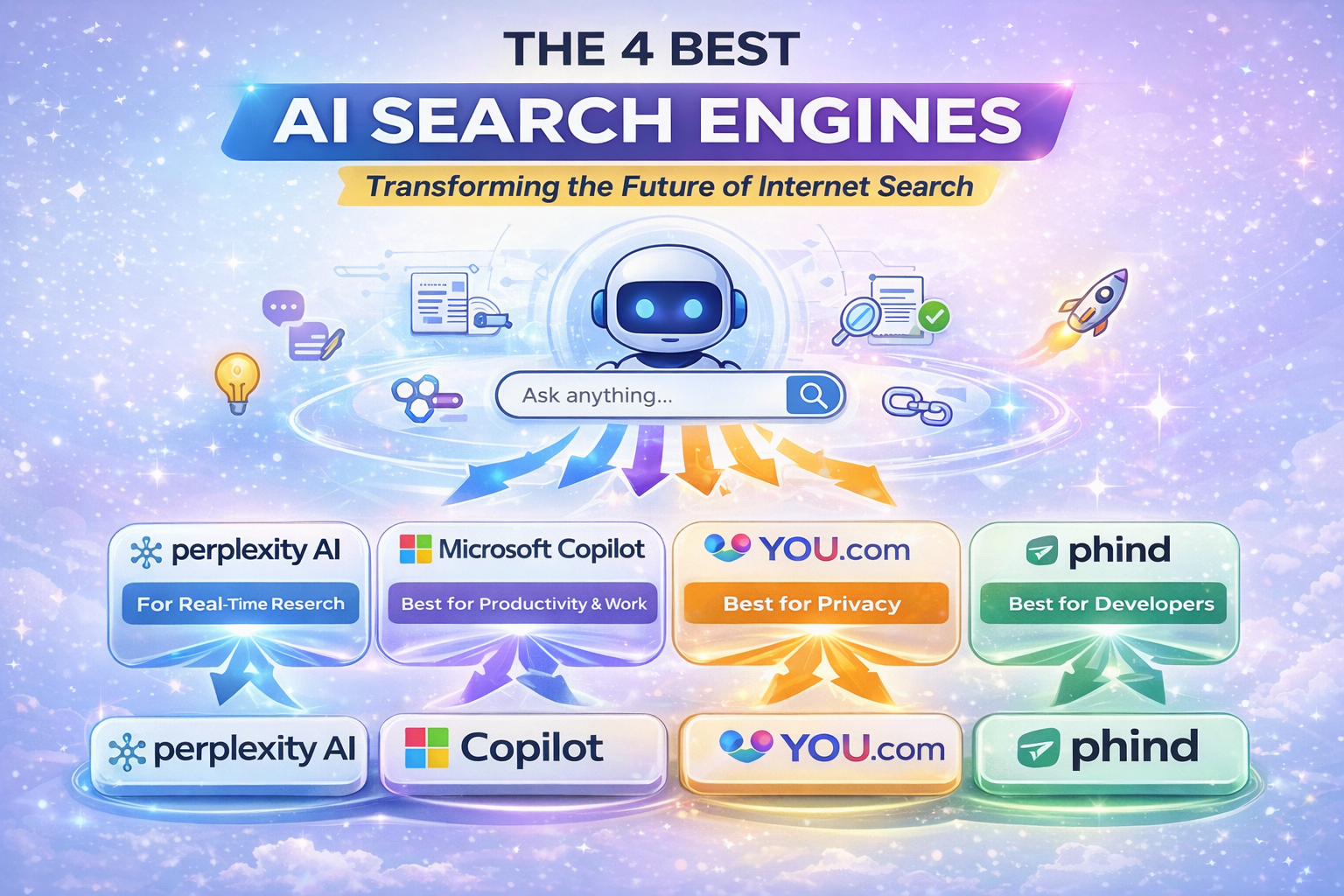
Introduction: Why AI Search Engines Are Changing the Internet
A few years ago, searching the internet usually meant typing a few keywords into a search engine and then scrolling through many links to find the right answer. Traditional search engines like Google Search mainly show a list of websites that might contain the information you need. While this method works, it often requires time and effort because users have to open multiple pages, read the content, and decide which source is actually useful.
However, the way people search for information online is now changing quickly. With the rise of artificial intelligence, a new generation of tools known as AI search engines has started to transform the search experience. Instead of only showing links, these systems can understand questions, analyze information from different sources, and generate clear answers in seconds.
This shift is one of the main reasons why many people are now exploring the 4 best AI search engines available today. These AI-powered platforms use advanced technologies such as natural language processing and machine learning to understand what users are asking and provide more helpful responses.
Another important difference is the way users interact with these tools. Traditional search often requires short keywords like “best AI tools” or “AI search engines list.” In contrast, AI search engines allow users to ask full questions in a natural way. For example, someone can ask, “What are the best AI search engines for research?” and receive a summarized explanation instead of a long list of websites.
This makes searching faster, simpler, and more conversational. Even beginners or young users can quickly understand complex topics because AI tools present information in a clearer format. As a result, many experts believe that AI-powered search will play a major role in the future of how we explore knowledge online.
In this article, we will explore the 4 best AI search engines, how they work, and why they are becoming an important part of modern internet searching. By the end of this guide, you will have a clear idea of which AI search tools are worth trying and how they can make online research easier.
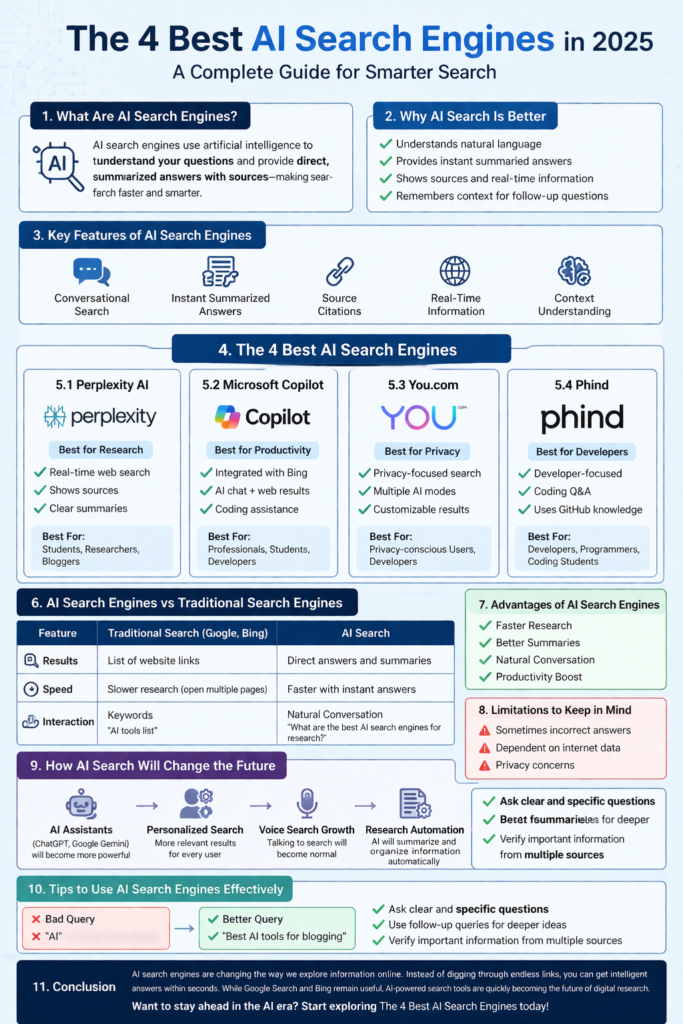
2. What Is an AI Search Engine?
An AI search engine is a modern type of search tool that uses artificial intelligence to understand questions and provide clear answers. Unlike traditional search engines that mainly display a list of websites, AI search engines try to understand the meaning of a user’s question and then generate a helpful response.
In simple words, an AI search engine acts more like a smart assistant than a basic search tool. You can ask it questions in natural language, and it will analyze information from multiple sources to give a summarized answer. This makes searching faster and easier, especially for beginners who may not want to open many different websites.
Traditional search engines such as Google Search usually work by matching keywords. For example, if someone searches for “best AI tools,” the search engine scans billions of webpages and shows links that contain similar words. The user then has to click on different websites to find the exact information they need.
AI search engines work in a smarter way. They use advanced technologies like natural language understanding to interpret the full meaning of a question. Instead of focusing only on keywords, the system tries to understand what the user is really asking. This allows people to type questions in a natural conversational style, just like talking to a human.
Another powerful feature of AI search engines is real-time information analysis. These systems can scan multiple sources, compare data, and generate a short summary that answers the user’s question directly. This saves time and reduces the need to read many long articles.
Some well-known examples of AI-powered search tools include ChatGPT and Perplexity AI. These platforms combine artificial intelligence with internet search to provide more interactive and informative results.
As AI technology continues to improve, many people are becoming interested in discovering The 4 Best AI Search Engines that can make research, learning, and daily online searches much easier. These tools are changing how we find information on the internet by making search more intelligent, faster, and user-friendly.
3. How AI Search Engines Work
To understand why these tools are becoming popular, it is important to know how AI search engines actually work behind the scenes. Unlike traditional search systems, AI-powered tools analyze a user’s question, study information from many sources, and then generate a clear answer.
Most platforms that are included in the 4 best AI search engines follow a similar step-by-step process to deliver results quickly and accurately.
Step 1: User Query
The process starts when a user asks a question. Instead of typing short keywords, people can ask full questions in natural language. For example, a user might ask, “What are the best AI search engines for students?”
Modern AI tools such as ChatGPT or Perplexity AI are designed to understand conversational questions, which makes searching feel more like talking to a smart assistant.
Step 2: AI Language Model Analysis
Once the question is submitted, the system analyzes it using natural language processing (NLP). NLP helps the AI understand the meaning, context, and intent behind the words.
For example, if someone asks about “best AI search engines,” the AI recognizes that the user is looking for tools, comparisons, or recommendations.
At this stage, the system may also use machine learning models that have been trained on large amounts of text data. These models help the AI understand patterns in language and predict the most relevant information.
Step 3: Information Retrieval
After understanding the question, the AI system searches for relevant information. This process is called information retrieval.
The AI scans web pages, articles, and databases to collect useful data. Advanced platforms analyze multiple sources at the same time to find accurate and reliable information.
This step is one reason why tools listed in the 4 Best AI Search Engines are becoming popular. They can gather data quickly from many sources instead of showing users hundreds of separate links.
Step 4: Answer Generation
The final step is answer generation. Instead of simply displaying a list of websites, the AI organizes the collected information and creates a clear response.
Many AI search engines also provide AI-generated summaries, which means they present the most important points in a short and easy-to-read format. This helps users understand the topic faster without reading long articles.
For students, beginners, or anyone doing research, this process makes online searching much more efficient. Instead of spending several minutes opening different websites, users can get helpful explanations within seconds.
Because of these advanced technologies—including NLP, machine learning, web data analysis, and AI summaries—the tools featured in The 4 Best AI Search Engines are transforming how people explore information on the internet.
4. Key Features of AI Search Engines
AI search engines are becoming popular because they offer smarter and faster ways to find information online. Unlike traditional search engines that mainly show a list of links, AI-powered search tools focus on giving clear answers and better understanding user questions.
When exploring the 4 best AI search engines, you will notice that most of them share several powerful features that make online searching easier and more efficient.
Conversational Search
One of the most important features of AI search engines is conversational search. Instead of typing short keywords, users can ask full questions just like they would ask a person.
For example, instead of searching “AI tools list,” a user can ask, “What are the best AI search engines for research?” The AI system understands the question and provides a clear response. Tools like ChatGPT allow users to interact with search technology in a natural and simple way.
Instant Summarized Answers
Another useful feature is the ability to provide instant summarized answers. AI search engines analyze information from multiple sources and then generate a short explanation that highlights the most important points.
This saves time because users do not need to open many different websites to find the information they need. Instead, they get a quick summary that is easy to read and understand.
Source Citations
Many modern AI search tools also include source citations. This means the system shows where the information comes from. For example, platforms like Perplexity AI often display references or links to the websites used in the answer.
This feature is important because it helps users verify the information and learn more from trusted sources.
Real-Time Information
AI search engines can also provide real-time information. They analyze current web data to deliver the latest updates on topics such as technology, news, and trends.
This makes AI-powered search tools useful for research, learning, and staying updated with new developments.
Context Understanding
Another powerful feature is context understanding. AI search engines remember the context of a conversation and can understand follow-up questions.
For example, if a user first asks about AI search engines and then asks, “Which one is best for students?”, the system understands that the second question is related to the first one.
Because of these advanced capabilities—such as conversational interaction, instant summaries, reliable sources, real-time updates, and context awareness—the tools discussed in The 4 Best AI Search Engines are quickly becoming a smarter alternative to traditional search methods.
5. The 4 Best AI Search Engines
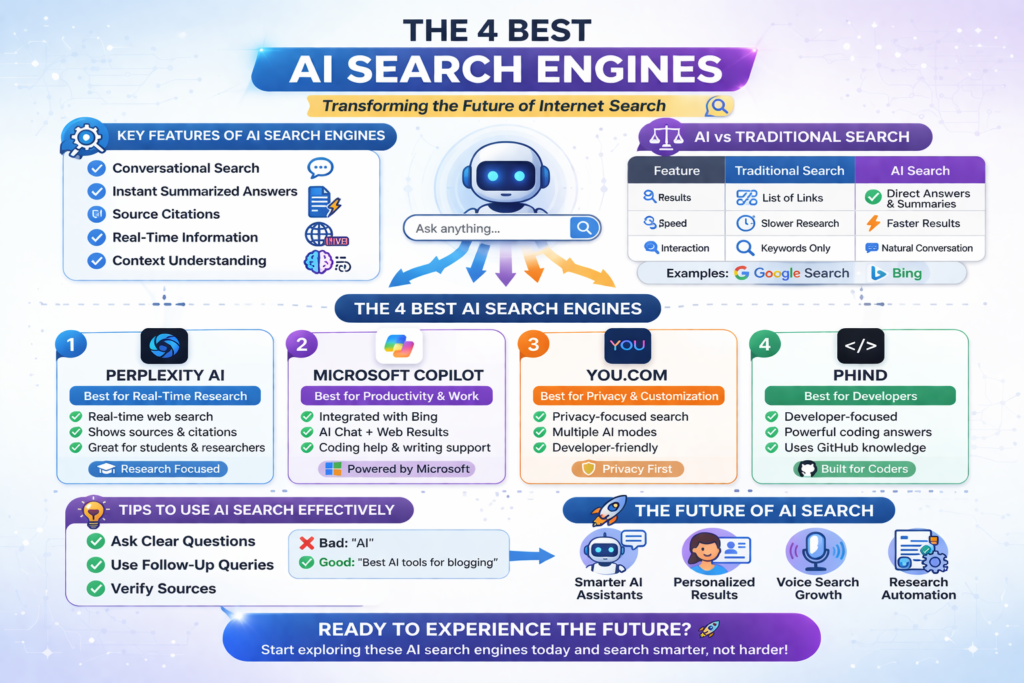
AI technology has completely changed the way people search for information on the internet. Instead of opening many different websites, modern AI search tools can understand a question and provide a clear answer within seconds. These platforms combine artificial intelligence with web search to make online research faster and easier.
In this section, we will explore The 4 Best AI Search Engines that are becoming popular among students, researchers, developers, and everyday internet users.
5.1 Perplexity AI
What Is Perplexity AI?
Perplexity AI is an AI-powered search engine designed to provide accurate answers with reliable sources. Unlike traditional search engines that mainly show a list of links, Perplexity AI gives direct explanations and also shows where the information comes from.
Because of its powerful research capabilities, it is often included in discussions about The 4 Best AI Search Engines available today.
How Perplexity AI Works
Perplexity AI uses advanced language models to understand the user’s question. After analyzing the query, the system searches the web in real time to collect useful information from multiple websites. It then organizes the data and generates a simple and easy-to-read answer.
At the same time, the platform shows the sources used for the response so users can verify the information.
Best Features
Some of the most useful features of Perplexity AI include:
Real-time web search that provides updated information
Source citations that show where the information comes from
Clear AI-generated summaries that make answers easy to understand
Follow-up question support for deeper research
Who Should Use Perplexity AI?
Perplexity AI is especially helpful for:
Students who need quick explanations
Researchers looking for summarized information
Bloggers and writers doing topic research
Anyone who wants reliable answers without opening many websites
Because of its ability to combine AI responses with real-time web data, Perplexity AI is widely considered one of The 4 Best AI Search Engines for research and learning.
5.2 Microsoft Copilot
What Is Microsoft Copilot?
Microsoft Copilot is an AI-powered assistant developed by Microsoft. It combines artificial intelligence with the search capabilities of Bing to help users find information and complete tasks more efficiently.
This tool works like a smart chatbot that can answer questions, summarize content, and even assist with writing or coding tasks.
Key Features
Some important features of Microsoft Copilot include:
Integration with Bing search for real-time web results
AI chat interface that allows conversational search
Content generation for writing, research, and brainstorming
Coding assistance for developers and programmers
Who Should Use Microsoft Copilot?
Microsoft Copilot is useful for many different types of users, including:
Professionals who want to improve productivity
Students working on research projects
Developers who need coding help
Writers looking for quick ideas or summaries
Because of its strong AI capabilities and integration with Microsoft services, Copilot is often listed among The 4 Best AI Search Engines for productivity and research.
5.3 You.com
What Is You.com?
You.com is another modern AI-powered search engine that focuses on privacy and customizable search experiences. It allows users to search the web using artificial intelligence while also controlling how their search results are displayed.
Many people prefer this platform because it offers a more personalized and private search experience.
Key Features
Some of the standout features of You.com include:
Privacy-focused search that limits tracking
Multiple AI modes for different types of tasks
Customizable search results based on user preferences
Developer-friendly tools for coding and technical queries
Who Should Use You.com?
You.com is ideal for:
Users who care about online privacy
Developers looking for AI-powered coding help
Researchers who want customizable search results
People interested in experimenting with different AI search modes
Because of its flexibility and privacy features, You.com is often mentioned when discussing The 4 Best AI Search Engines available today.
5.4 Pind
What is Pind?
Phind is an AI search engine designed specifically for programmers and developers. It focuses on technical questions, coding problems, and software development topics.
Unlike general AI search engines, Phind is optimized to understand programming-related queries and provide accurate coding explanations.
Key Features
Some powerful features of Phind include:
Developer-focused AI search for programming questions
Detailed coding explanations for different languages
Integration with technical knowledge sources such as coding documentation
Fast AI-generated solutions for debugging and learning
Who Should Use Pind?
Who Should Use Pind?
Phind is especially useful for:
Software developers
Programming students
Engineers working on technical projects
Anyone learning coding or debugging software
Because it specializes in programming knowledge and technical problem-solving, Phind is widely considered one of The 4 Best AI Search Engines for developers.
Together, these tools demonstrate how artificial intelligence is transforming the way people search for information online. Each platform in The 4 Best AI Search Engines offers unique features designed to make research, learning, and problem-solving faster and more efficient.
6. AI Search Engines vs Traditional Search Engines
To understand why many people are now interested in The 4 Best AI Search Engines, it is important to compare them with traditional search engines. For many years, people have used platforms like Google Search and Bing to find information on the internet. These tools are still very powerful, but the way they provide results is different from modern AI search systems.
Traditional search engines mainly work by matching keywords and showing a list of websites related to the search query. Users then need to open multiple links and read the content to find the answer they are looking for.
AI search engines, on the other hand, use artificial intelligence to understand the meaning of the question and provide a direct response. Instead of only displaying links, they generate summaries, explanations, and sometimes even step-by-step answers.
The following table shows a simple comparison between traditional search engines and AI-powered search tools.
| Feature | Traditional Search | AI Search |
|---|---|---|
| Results | List of website links | Direct answers and summaries |
| Speed | Slower because users must read many pages | Faster because answers are summarized |
| Interaction | Short keywords like “AI tools list” | Natural conversation like asking a question |
Another important difference is how users interact with the system. In traditional search engines such as Google Search, users usually type short phrases or keywords. For example, someone might search for “best AI search engines.” The search engine then displays many articles related to that topic.
In contrast, AI search tools allow users to ask full questions such as “Which AI search engine is best for research?” The system analyzes the question and generates a clear response. This conversational approach makes searching easier, especially for beginners or younger users.
This is one of the main reasons why more people are exploring The 4 Best AI Search Engines. These tools combine the power of traditional web search with artificial intelligence, making it possible to find information faster and in a more user-friendly way.
7. Advantages of AI Search Engines
AI technology has made online searching much easier and more efficient. Instead of spending a lot of time opening different websites, AI search engines can quickly understand a question and provide a helpful answer. This is one of the main reasons why many people are now exploring The 4 Best AI Search Engines for research, learning, and everyday internet use.
Below are some of the most important advantages of using AI-powered search tools.
Faster Research
One of the biggest benefits of AI search engines is speed. Traditional search platforms such as Google Search or Bing usually show a long list of websites. Users must open several pages and read the information before finding the right answer.
AI search engines work differently. They analyze multiple sources quickly and provide a summarized explanation in seconds. This makes research much faster, especially for students, bloggers, and professionals who need information quickly.
Better Summaries
Another advantage of AI search engines is their ability to create clear and simple summaries. Instead of showing long articles, the AI highlights the most important points and presents them in an easy-to-read format.
This is very helpful for beginners or younger users because they can understand complex topics without reading large amounts of text. Many tools included in The 4 Best AI Search Engines focus on generating short explanations that save time and improve learning.
Natural Conversation
AI search engines also allow users to search using natural conversation. Instead of typing short keywords, people can ask full questions like they are talking to a person.
For example, someone can ask, “Which AI search engine is best for research?” The AI system understands the question and provides a direct response. This conversational style makes the search experience more comfortable and user-friendly.
Productivity Boost
Using AI search engines can also improve productivity. Because these tools provide quick answers and summarized information, users can complete tasks faster.
Students can finish research more quickly, writers can gather ideas for articles, and professionals can find important information without wasting time searching through many websites.
For these reasons, many experts believe that tools included in The 4 Best AI Search Engines are helping people work smarter and learn more efficiently. By combining artificial intelligence with web search, these platforms are transforming the way we find information online.
8. Limitations of AI Search Engines
While AI-powered search tools offer many benefits, it is also important to understand their limitations. Talking about both advantages and disadvantages helps build trust with readers and follows the principles of Google E-E-A-T. Even though many people are now exploring The 4 Best AI Search Engines, these tools are still evolving and are not perfect.
Below are some common limitations of AI search engines.
Sometimes They Can Give Incorrect Answers
AI search engines are designed to analyze information and generate responses, but they can sometimes make mistakes. Because they rely on data from different sources, the AI may occasionally provide an answer that is incomplete or not fully accurate.
For example, tools like ChatGPT or Perplexity AI usually give helpful explanations, but users should still verify important information, especially for academic research or professional work.
Dependence on Internet Data
Another limitation is that AI search engines depend heavily on internet data. If the available information online is outdated or limited, the AI may not always provide the best answer.
In addition, most AI search tools require an active internet connection to analyze web data and generate responses. Without internet access, these systems cannot perform real-time searches.
Privacy Concerns
Privacy is another topic that many users think about when using AI-powered platforms. Some search tools collect user queries and interaction data to improve their systems. While this helps the AI learn and provide better answers, some people may feel concerned about how their data is used.
Because of this, users should always read the privacy policies of the tools they use and choose platforms that follow responsible data practices.
Why Understanding Limitations Is Important
Even with these challenges, AI search technology is improving quickly. Many platforms included in The 4 Best AI Search Engines are constantly updating their systems to provide more accurate answers, better security, and improved user experiences.
By understanding both the strengths and limitations of AI search engines, users can use these tools more wisely and get the most value from them.
9. How AI Search Will Change the Future of the Internet
The way people search for information online is changing very quickly. In the past, users had to type keywords and browse many websites to find useful information. Today, artificial intelligence is making search smarter, faster, and more interactive. Because of this shift, many technology experts believe that AI-powered tools — including The 4 Best AI Search Engines — will play a major role in shaping the future of the internet.
Below are some important ways AI search technology may change how we use the web in the coming years.
AI Assistants Will Become More Powerful
One major trend is the rise of intelligent AI assistants that can answer questions, complete tasks, and help users learn new things. Tools such as ChatGPT and Google Gemini are already showing how AI can provide detailed explanations and assist with everyday tasks.
In the future, AI assistants may become a central part of online search. Instead of visiting many websites, users might rely on one AI system that can find information, summarize it, and explain it clearly.
Personalized Search Experiences
Another important change will be personalized search results. AI systems can learn from user preferences and search history to provide more relevant answers.
For example, if a student often searches for educational topics, the AI may prioritize learning resources and simple explanations. This personalized experience can make online searching more efficient and user-friendly.
Many platforms included in The 4 Best AI Search Engines are already experimenting with personalized search features.
Growth of Voice Search
Voice technology is also becoming more common. Many people now prefer speaking to their devices instead of typing. AI search engines are making this possible by understanding spoken language and responding in a conversational way.
In the future, voice search could become one of the main ways people interact with the internet. Users may simply ask a question aloud and receive an instant answer from an AI system.
Research Automation
Another exciting possibility is research automation. AI search tools are becoming capable of analyzing large amounts of information and creating summaries automatically.
For students, researchers, and professionals, this could save a huge amount of time. Instead of reading dozens of articles, users may receive well-organized summaries that highlight the most important points.
Because of these advancements, the tools discussed in The 4 Best AI Search Engines represent more than just new search platforms. They are part of a bigger transformation in how humans access knowledge and interact with information online. As AI technology continues to improve, the future of internet search will likely become more intelligent, more conversational, and much more efficient.
10. Tips to Use AI Search Engines Effectively
AI search engines can make online research faster and easier, but getting the best results also depends on how you ask your questions. When users learn how to interact with these tools properly, they can find better answers in less time. This is especially useful when exploring The 4 Best AI Search Engines, which are designed to understand natural language and provide helpful responses.
Below are some practical tips that can help you use AI search engines more effectively.
Ask Clear and Specific Questions
One of the best ways to get accurate answers from an AI search engine is to ask clear and specific questions. If your query is too short or vague, the AI may not fully understand what information you need.
For example:
Bad Query:
AI
Better Query:
Best AI tools for blogging
The second question is clearer, so the AI can provide more relevant results. Platforms like ChatGPT work much better when users write complete questions instead of single keywords.
Use Follow-Up Questions
Another useful tip is to ask follow-up questions. AI search engines are designed to understand the context of a conversation. This means you can continue asking related questions without repeating the entire topic.
For example, you might first ask about the best AI search tools. Then you could ask another question like, “Which one is best for students?” The system will understand that the second question is connected to the first one.
This conversational style makes research easier and helps users explore topics in more depth.
Verify Information from Multiple Sources
Even though AI search engines are very powerful, it is always a good idea to verify important information. Many AI tools collect data from different websites and generate summaries, but checking multiple sources can help confirm accuracy.
Some platforms, such as Perplexity AI, show references or source links so users can explore the original information.
Why These Tips Matter
Learning how to ask better questions and verify answers can make a big difference when using AI search tools. These simple habits help users get more reliable information and avoid misunderstandings.
As more people start using The 4 Best AI Search Engines, understanding how to interact with AI systems will become an important digital skill. By asking clear questions, using follow-up queries, and checking trusted sources, anyone can make the most of AI-powered search technology.
11. Conclusion
The way we search for information on the internet is changing faster than ever. In the past, people had to go through many different websites to find a single useful answer. Today, AI-powered search tools can understand questions and provide clear explanations within seconds.
Throughout this guide, we explored The 4 Best AI Search Engines and how they are helping users find information more efficiently. These tools are designed to understand natural language, analyze web data, and present answers in a simple and easy-to-understand format. Because of this, students, researchers, bloggers, and everyday internet users can save time and learn faster.
Although traditional search engines like Google Search still play an important role, AI search engines are quickly becoming a powerful alternative for research and learning. As artificial intelligence continues to improve, these tools will likely become even smarter and more helpful.
If you want to stay ahead in the AI era, start exploring The 4 Best AI Search Engines today and see how they can make your online research faster, easier, and more productive.